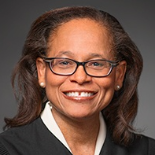

Natalie E. Hudson
Non-Partisan | Minnesota


Candidate Profile

Leans Activist

BIOGRAPHY
EDUCATION
Candidate did not provide
WORK & MILITARY
Candidate did not provide
AFFILIATIONS
Candidate did not provide
POLITICAL OFFICES HELD
Candidate did not provide
POLITICAL OFFICES SOUGHT
Candidate did not provide
SELECTED CONTRIBUTIONS
LIBERAL
GIVEN BY CANDIDATE (0)
RECEIVED BY CANDIDATE (1)
Dorsey Political Fund (2016)
OTHER INFORMATION
State v. Abdus-Salam, 1 N.W.3d 871 (Minn. 2024). Participant.
Holding: The Court affirmed the court of appeals. The Court concluded that, “A reasonable juror could conclude that death or great bodily harm is a probable or reasonably expected result when a vehicle spins ‘donuts’ mere inches from dozens of excited onlookers. The facts in the record could support a jury finding that the vehicles were likely to produce death or great bodily harm based on the manner in which they were being used. As a result, the district court erred when it granted Abdus-Salam’s pretrial motion to dismiss the two second-degree riot charges for lack of probable cause.” (13)
Analysis: The Court stated that under the definition of dangerous weapon, “an everyday object not traditionally considered a weapon may nevertheless become a dangerous weapon if the object is used in a manner calculated or likely to produce death or great bodily harm.” (5) The Court “first ask[ed] whether we have defined ‘likely’ in the manner-of-use definition of a dangerous weapon.” (5)
The Court first examined whether it had defined "likely" within the context of the manner-of-use definition for a dangerous weapon. The Court looked to Gebremarian and concluded that “Because dictionaries uniformly define ‘likely’ as having at least a better chance of occurring than not, see discussion infra Section I.B, using the phrase ‘known to be capable of’ arguably creates a lower threshold for the State to meet when asserting that a device or instrumentality is a “dangerous weapon.
Next the Court “determined what ‘likely’ does mean[t] in the context of the manner-of-use definition of a dangerous weapon.” (8) The Court said, ‘[t]he object of statutory interpretation is ‘to effectuate the intent of the Legislature.’ State v. Powers, 962 N.W.2d 853, 858 (Minn. 2021) (citing Minn. Stat. § 645.16 (2020)). The first step is to determine whether the statute’s language is ambiguous. State v. Loveless, 987 N.W.2d 224, 250 (Minn. 2023). Statutory language is ambiguous if it is subject to more than one reasonable interpretation. State v. Culver, 941 N.W.2d 134, 139 (Minn. 2020). When the statutory language has only one reasonable interpretation, it is unambiguous, and [the Court] appl[ies] its plain meaning. Id.” (8) Ultimately, the Court concluded that "likely" should be interpreted as "probable or reasonably expected" within the context of defining a dangerous weapon by its manner of use.
Background: Ayyoob Dawood Abdus-Salam was charged with two counts of second-degree riot, which requires either being armed with a dangerous weapon or knowing another participant is armed. Abdus-Salam allegedly organized two intersection “takeovers” where crowds blocked streets while drivers performed stunts. The State argued that the vehicles used in the riots were dangerous weapons due to how they were employed. The district court initially dismissed the charges, citing a lack of probable cause regarding the vehicles' classification. However, the court of appeals reversed this decision, finding enough evidence to suggest the vehicles could be seen as dangerous weapons. The Court’s analysis focused interpreting “dangerous weapon” under Minnesota law.
The Court was asked to determine: 1) how to interpret "likely" within the statutory definition of a dangerous weapon, and 2) whether the district court erred in dismissing the criminal complaints for lack of probable cause.
Applicable Law: “Under Minnesota’s criminal code, ‘dangerous weapon’ means: [A]ny firearm, whether loaded or unloaded, or any device designed as a weapon and capable of producing death or great bodily harm, any combustible or flammable liquid or other device or instrumentality that, in the manner it is used or intended to be used, is calculated or likely to produce death or great bodily harm, or any fire that is used to produce death or great bodily harm. Minn. Stat. § 609.02, subd. 6 (emphasis added).” (4-5)
Concerning element: the Court looked to precedent first to define “likely” mean in the context of the manner-of-use statutory definition for a dangerous weapon, then looked to whether the statute was clear or ambigious before looking to dictionary definitions
About Chief Justice Natalie Hudson:
"As a judge, Chief Justice Hudson no longer advocates for the interests of individual clients. Instead, she passionately advocates for all Minnesotans, ensuring that they have access to fair courts that uphold the law and respond to the public trust."
“I believe the Supreme Court must safeguard the integrity of the judicial process, for true justice is not simply a result; it is also a process. Even a correct result reached by a court may be tarnished if the integrity of the process that produced it is in question. One way to guard against this is by ensuring the fair, equitable, and respectful treatment of all parties coming before the courts, irrespective of their relative stations or affiliations. When parties have been treated equitably and respectfully, their perception of the judicial process is bolstered, such that the court’s result, whether adverse or favorable is accepted as fair. As judges we must never forget that behind each legal issue presented before the Court are real, human lives, which will be greatly impacted by our decisions.”
State v. Cummings, 2 N.W.3d 528 (Minn. 2024). Authored.
Synopsis: The Court concluded that the term "resources" in Minnesota Statutes section 611A.045, subdivision 1(a)(2), refers to useful and valuable possessions. In this case, it determined that Baion's home equity qualified as a resource for restitution, even though it was co-owned with his spouse. The Court affirmed the court of appeals' ruling, which held that home equity can be monetized and leveraged for financial support, making it relevant in assessing Baion's ability to pay restitution. The Court upheld the district court's decision.
Holding(s): Affirmed the court of appeals. The Court “conclude[d] that the term ‘resources’ unambiguously means useful and valuable possessions.” (2) The Court further held that “Home equity, even when the home is co-owned with a non- defendant spouse, may be a useful and valuable possession.” (2)
The Court held that, despite the differing definitions, they ultimately converged on a single interpretation: "resources" meant useful and valuable possessions. The Court found the different proposed definitions did not lead to conflicting outcomes and accurately reflected the term's plain meaning in the context of the restitution statute. The court of appeals noted that the statute does not differentiate among types of resources and imposes no limitations on what a district court may consider when determining a defendant's ability to pay restitution.
The Court clarified that while it adopted a broad definition of "resources," this definition is not without limits. In the context of determining restitution amounts, "valuable possession" refers strictly to monetary value, excluding sentimental value. Additionally, to be "useful," a resource must be monetizable; it should enable the defendant to access money for restitution without needing to transfer ownership of assets. Finally, the Court noted that the resource must be a possession of the defendant, allowing for partial ownership interests to qualify as resources for restitution under Minnesota Statutes section 611A.045, subdivision 1.
Analysis: The court reviewed statutory language de novo, affirming that if a statute's intent is clear, it should be interpreted based on its plain meaning without additional construction. The Court found “resource” had no statutory definition. The court considered whether "resources" was ambiguous and looked to dictionary definitions for context, noting that the plain meaning would prevail if the term could not be reasonably interpreted in multiple ways.
Baion argued that the term "resources" in section 611A.045 refers to a measure of the defendant’s ability to financially compensate the victim, defining it narrowly as “an available supply that can be drawn on when needed” (The American Heritage Dictionary 1495 (5th ed. 2011)). In contrast, the State advocated for a broader definition, noting that a "resource" could also mean “something that is available for use or that can be used for support or help” and “a useful or valuable quality or possession” (Black’s Law Dictionary 1568 (11th ed. 2019)).
Background: In October 2020, Joshua Henry Baion Cummings was charged with theft after submitting fraudulent personal care assistant records. He entered an Alford plea to one count of theft while reserving the right to challenge restitution. At sentencing, the district court included his home equity as a resource for restitution, ordering him to pay $14,579.62. Baion appealed, arguing that home equity shouldn't count as a resource. The court of appeals upheld the decision, affirming that home equity qualifies as a resource under Minnesota law. This court later granted further review of the case.
Applicable Law:
- “Minnesota Statutes section 611A.045, subdivision 1(a) provides: “The court, in determining whether to order restitution and the amount of the restitution, shall consider the following factors: (1) the amount of economic loss sustained by the victim as a result of the offense; and (2) the income, resources, and obligations of the defendant.” This case requires us to interpret the term ‘resources’ in section 611A.045, subdivision 1(a)(2). ‘We review issues of statutory interpretation de novo.’ Hagen v. Steven Scott Mgmt., Inc., 963 N.W.2d 164, 169 (Minn. 2021).” (4-5)
- In interpreting statutes, Minnesota courts adhere to the principle that when the legislative intent is clear from the statute's plain and unambiguous language, the statute should be applied according to its plain meaning without resorting to further construction (State v. Serbus, 957 N.W.2d 84, 87 (Minn. 2021)). To assess whether a word is ambiguous, courts consider if it can be subject to more than one reasonable interpretation; if it cannot, the plain meaning controls (State v. Bowen, 921 N.W.2d 763, 765 (Minn. 2019); State v. Pakhnyuk, 926 N.W.2d 914, 920 (Minn. 2019)). Furthermore, the interpretation of words and phrases is guided by rules of grammar and their common usage, with courts permitted to consult dictionary definitions when legislative definitions are absent (Minn. Stat. § 645.08 (2022); State v. Powers, 962 N.W.2d 853, 858 (Minn. 2021)). Finally, the relevant definition of a term is context-dependent, emphasizing that the application of statutory language can vary based on its specific use (State v. Alarcon, 932 N.W.2d 641, 646 (Minn. 2019)). (6-7)
Minnesota Voters All. v. Hunt, 10 N.W.3d 163 (Minn. 2024). Authored.
Holding(s): The Court affirmed the district court’s decision denying the “petition for write of quo warranto or declaratory judgement.” (13) The Court held the individual taxpayers didn’t meet the requirements for taxpayer standing. (8) Further the Court held that Minnesota Voter’s Alliance lacked associational standing because its members, the taxpayers, did not have standing to sue.
Analysis: The court found that the taxpayers lacked taxpayer standing for several reasons. The court reviewed its history with taxpayer standing, noting that in Regan v. Babcock, it affirmed that taxpayers have standing to challenge illegal expenditures of public funds.In McKee v. Likins, the court reiterated that taxpayer standing exists primarily to challenge unlawful use of public funds. Additionally the Court found the holding In re Sandy Pappas Senate Committee, underscored the necessity of a direct challenge to expenditures of public funds for taxpayer standing to apply. The court concluded that the taxpayers in this case were not alleging a specific illegal expenditure but rather sought to restrain general actions of public officials, which did not meet the threshold for taxpayer standing.
In this case, the expenditures related to educating individuals about their voting rights were not central to the statute's enforcement and did not require legislative funding. The Court found that granting taxpayer standing based on incidental expenses would undermine the very concept of taxpayer standing, potentially allowing any law involving some public expenditure to be challenged. Thus, the court concluded that the taxpayers could not manufacture standing through incidental costs and reaffirmed their lack of standing in this matter. The Court held “that when standing would not otherwise exist to challenge a substantive law, a taxpayer cannot manufacture standing by pointing to expenditures that are incidental to implementing the law.” (12)
Background: The case centers on the Re-Enfranchisement Act, which affects the voting rights of individuals convicted of felonies, as outlined in Article VII of the Minnesota Constitution. This article stipulates that while citizens aged 18 and older generally have the right to vote, those convicted of felonies cannot do so unless their rights are restored. The Minnesota Supreme Court clarified that restoration must occur through an affirmative governmental act, such as a pardon or legislative action. Following this, the Re-Enfranchisement Act was enacted, allowing individuals not incarcerated for a felony to have their voting rights restored. It included provisions for educating voters about their rights, funded by a $200,000 appropriation for an educational campaign.
In 2023, individual taxpayers Mary Amlaw, Ken Wendling, and Tim Kirk, along with the Minnesota Voters Alliance, petitioned against state officials implementing the Act, arguing it unlawfully allowed the restoration of only the right to vote, contrary to the requirement for restoring all civil rights. They also argued that public funds should not be used to educate the public about this provision if found to violate the Constitution. The district court denied the petition, ruling that they lacked legal standing to bring the case.
The district court dismissed their petition, ruling they lacked standing because their challenge did not involve a specific misuse of public funds, and they could not establish that any member of their association had standing. The court emphasized that granting taxpayer standing in such a case would undermine the concept of standing itself, as virtually every law involves some public expenditure.
Applicable Laws:
- “Article VII of the Minnesota Constitution broadly protects the right to vote: ‘Every person 18 years of age or more who has been a citizen of the United States for three months and who has resided in the precinct for 30 days next preceding an election shall be entitled to vote in that precinct.’ Minn. Const. art. VII, § 1.” (3-4)
- “In discussing the constitutional restriction on a person convicted of a felony’s right to vote, [the Court] ha[s] said, [T]he rule under Article VII, Section 1, of the Minnesota Constitution is as follows: a person convicted of a felony cannot vote in Minnesota unless the person’s right to vote is restored by some affirmative act of, or mechanism established by, the government. For instance, the affirmative act could be an absolute pardon that nullifies that felony conviction upon which the constitutional deprivation of the right to vote is based or a legislative act that generally restores the right to vote upon the occurrence of certain events. Schroeder v. Simon, 985 N.W.2d 529, 545 (Minn. 2023) (emphasis added).”
- (Following Schroeder) “The new voting provision of the Re-Enfranchisement Act amended Minnesota Statutes section 201.014 (2022) by adding the following language: An individual who is ineligible to vote because of a felony conviction has the civil right to vote restored during any period when the individual is not incarcerated for the offense. If the individual is later incarcerated for the offense, the individual’s civil right to vote is lost only during that period of incarceration. Act of Mar. 3, 2023, ch. 12, § 1, 2023 Minn. Laws at 64. ” (4)
- “To have standing, a party must have a sufficient stake in a justiciable controversy to seek relief from a court,’ meaning it has ‘suffered some injury in fact’ or ‘is the beneficiary of some legislative enactment granting standing.’ State ex rel. Humphrey v. Philip Morris Inc., 551 N.W.2d 490, 493 (Minn. 1996)” (7)
- “Taxpayers without a direct or personal injury may still have standing to bring an action to restrain the unlawful use of public funds. McKee v. Likins, 261 N.W.2d 566, 570 (Minn. 1977).” (7)
- “Associational standing cannot be invoked unless a member of the association has standing. State ex rel. Humphrey, 551 N.W.2d at 497–98.” (7)
Rygwall as Tr. for Rygwall v. ACR Homes, Inc., No. A22-1376, 2024 WL 2164658 (Minn. May 10, 2024). Hudson joined dissent.
Holding(s): The Court “reverse[d] the decision of the court of appeals and remand[ed] to the district court for further proceedings consistent with this opinion.” (39) The Court held that “ACR forfeited neither its causation argument nor its right to rely on cases citing section 145.682 in making that argument.” (17) The Court noted that ACR did not move to dismiss the claims under section 145.682, but instead moved for summary judgement. The Court held that Section 145.682 did not modify the common-law standard for medical malpractice to cases. The Court stated, “[r]ather than abrogating the common law, the statute instead incorporates it by reference.” (23) Additionally, the Court found “the statute [] purely procedural[.]” (23)
Overall the Court held that “Rygwall raised a genuine issue of material fact as to whether ACR caused her daughter’s death. Based on this record, a reasonable jury could find in Rygwall’s favor on the issue of causation, and therefore summary judgment for ACR is inappropriate.” (39) The Court found “that Rygwall created a genuine issue of material fact as to whether Amy would have received antibiotics had she sought emergency medical treatment earlier.” Additionally, the Court held “that there [wa]s sufficient evidence in the record to allow a reasonable jury to conclude, without speculation, that had ACR taken Amy for emergency treatment immediately after ACR learned about the aspiration event at Rise, she would have been timely treated with antibiotics, and her condition would not have deteriorated into the sepsis, organ failure, and ARDS that resulted in her death.” (38-39)
Dissent: “Although I agree with the court’s holding that Minn. Stat. § 145.682 (2022)—and the cases interpreting it—did not create a higher bar for causation in medical malpractice cases, I disagree that the expert affidavit here was sufficient to establish causation. Accordingly, [Anderson] concur[red] as to Part I of the court’s opinion but otherwise respectfully dissent[ed].” (40) Anderson disagreed a jury would find in favor or Rygwall as “ACR found two gaps in the chain of causation: would Amy have received earlier treatment had ACR called 911, and would that treatment have prevented Amy’s death?” (40) Anderson emphasized that the significant change in Amy's symptoms over time made it speculative to conclude that earlier intervention would have altered her outcome. Additionally he argued that without expert testimony clearly connecting ACR's alleged negligence to Amy's injuries, the claim could not survive summary judgment.
Background: The case involves an appeal from a district court's summary judgment in favor of ACR regarding the death of Amy, who had severe disabilities and required constant care of ACR Homes, Inc. In 2015, she aspirated food, leading to respiratory distress characterized by coughing, foaming saliva, raspy breathing, and skin color changes. An ACR staff member, aware of these symptoms, chose not to call 911 and instead searched for an urgent care clinic based on insurance and wait times. After transporting Amy over an hour to an urgent care clinic in St. Paul, her condition worsened, necessitating hospital care where she received antibiotics and treatment for aspiration pneumonia. Amy died 13 days later from related complications.
Applicable Law:
- “Section 145.682, subdivision 6(c) provides: Failure to comply with subdivision 4 because of deficiencies in the affidavit or answers to interrogatories results, upon motion, in mandatory dismissal with prejudice of each action as to which expert testimony is necessary to establish a prima facie case, provided that: (1) the motion to dismiss the action identifies the claimed deficiencies in the affidavit or answers to interrogatories; (2) the time for hearing the motion is at least 45 days from the date of service of the motion; and (3) before the hearing on the motion, the plaintiff does not serve upon the defendant an amended affidavit or answers to interrogatories that correct the claimed deficiencies. Minn. Stat. § 145.682, subd. 6(c) (2022).” (See footnote 4)
- “For medical malpractice claims...a plaintiff must show that it is ‘more likely than not that the defendant’s conduct was a substantial factor in bringing about the result.’ Walton v. Jones, 286 N.W.2d 710, 715 (Minn. 1979) (quoting Walstad v. Univ. Of Minn. Hosps., 442 F.2d 634 (8th Cir. 1971)).” (20)
- “As long as the jury can reasonably infer from the evidence, without speculation, that the defendant caused the plaintiff’s injury (including death), summary judgment is not appropriate.”
Cruz-Guzman v. State, 916 N.W.2d 1 (Minn. 2018). Authored.
Holding: The Court held that it could review claims that the legislature had violated the state constitution's requirement to provide an adequate education. (3-4, 17) The Court also held that the legislators did not have immunity for allegedly failing to fulfill their constitutional obligations. (20)
Background: The Court addressed "whether claims alleging that the State ha[d] failed to provide students with an adequate education are justiciable." (3) In 2015, appellants filed a lawsuit against various Minnesota state entities, claiming racial and socioeconomic segregation in Minneapolis and Saint Paul public schools led to inadequate educational outcomes. They sought to represent children enrolled in these schools, alleging violations of the Minnesota Constitution's Education, Equal Protection, and Due Process Clauses due to state policies contributing to segregation. The district court denied the state's motion to dismiss, but the court of appeals reversed this, ruling the claims presented a nonjusticiable political question.
Cruz-Guzman v. State, 998 N.W.2d 262 (Minn. 2023). Dissented. *involed key issue*
Holding(s): The Court remanded the case to the district court for further proceedings concluding that “racial imbalances …standing alone, [were] not sufficient to establish a violation of the Education Clause.” (4) The Court held “that [the parents] must show that the racial imbalances are a substantial factor in causing their children to receive an inadequate education.” (5) The Court “rejected the district court’s ruling that to prevail on their Education Clause claim, the parents must establish that the State’s actions directly caused the challenged racial imbalances.” (24) The court establishes a standard for causation in Education Clause claims, stating that causation is indeed necessary, and adopts the "proximate cause" standard, requiring the conduct or action to be a significant factor in causing the injury. The Court found this standard acknowledges the complexity of factors contributing to an inadequate education, including racial imbalances, and requires proof that such imbalances are a substantial factor in causing the deficiency in education.
Notes: Overall the conclusion seems accurate and most of the analysis is good, but the court did no analysis before deciding a substantial factore standard was appropriate. The agree that racial imbalance alone is insufficient to est violation of Est. Clause but disagree with the conclusion that the parents must show racial imblalance plays a substantial factor in the imbalance. No precedent was cited, no analysis was done and no where in the Const. text does it say this.
Dissent: Hudson dissented, “Because [she] would hold that the de facto segregation in Minneapolis and Saint Paul public schools [wa]s sufficient, standing alone, to establish a violation of the Education Clause[.]" (D-3) Looking to the factors established in Pauley v. Kelly, 255 S.E.2d 859 (W. Va. 1979) Hudson concluded that “a system of segregated schools in Minneapolis and Saint Paul violates the Legislature’s duty to furnish an adequate education to all students in Minnesota.” (D-7) Justice Hudson also disagreed that “a plaintiff must show that segregation is a ‘substantial factor’ in bringing about an adequate education” finding that the “holding ha[d] no basis in the text of the Education Clause, and its undermines the Clause’s purpose in providing all Minnesota students with ‘an education which will fit them to discharge intelligently their duties as citizens of the republic.’” (D-3) notes: I agree with Hudson regarding the standard established by the majority, but holding overall incorrect.
Snell v. Walz, No. A21-0626, 2024 WL 2169290 (Minn. May 10, 2024). Signed Moore, III majority. *involved key issue*
Holding(s): The Court affirmed the holding of the court of appeals concluding that the governor was authorized to declare a peacetime emergency in response to the COVID-19 pandemic. (The court of appeals affirmed the district court’s holding that the Emergency Management Act authorized Governor Walz to declare a peacetime emergency.)
The Court first concluded “that the Act authorize[d] a governor to declare a peacetime emergency []” finding that “a pandemic is capable of satisfying all of the requirements set by the Legislature[.]” (12) The Court found the declaration qualified as an “act of nature” and that it “endangerd[] life and property.” (11) The Court said, “... a pandemic may also endanger property, as the population of healthy people necessary to make use of a property is reduced or incapacitated.” The Court next held that Governor Walz was authorized to declare a peacetime emergency due to COVID-19. The Court found that the governor was not required to “show” or “demonstrate” certain conditions to declare a peacetime emergency. Snell argued that “the word ‘only’ ...is restrictive, and ...unambiguously signals that the Governor must make an antecedent evidentiary showing before invoking emergency powers.” (12) The Court held that use of the word only did restrict the governor, but that “it does not follow that he has the additional burden of demonstrating that those conditions are present before acting.” (13) Court referenced canons of interpretation that precluded it from “overrid[ing] the plain language of a clear and unambiguous statute.” (14) The Court concluded last that the Act does not violate the nondelegation doctrine finding that “[t]he limitations on the scope of powers delegated, the non-illusory checks on the executive’s exercise of the delegated powers, and the material differences between this Act and other unconstitutional delegations of power all support our conclusion.” (18)
Background: The Court asked “whether the Emergency Management Act, Minn. Stat. §§ 12.01–.61 (2022), authorized Governor Walz to declare a peacetime emergency in response to the COVID-19 pandemic.” (2) “Whether the Act violates the nondelegation doctrine.” (16)
Applicable law:
- “The Emergency Management Act (the Act) confers upon the Governor of Minnesota the emergency and disaster powers to ‘(1) ensure that preparations of this state will be adequate to deal with disasters, (2) generally protect the public peace, health, and safety, and (3) preserve the lives and property of the people of the state.’ Minn. Stat. § 12.02, subd. 1.” (3)
- “The Governor may declare a peacetime emergency ‘only when an act of nature, a technological failure or malfunction, a terrorist incident, an industrial accident, a hazardous materials accident, or a civil disturbance endangers life and property and local government resources are inadequate to handle the situation.’ Minn. Stat. § 12.31, subd. 2(a).” (3)
In re Welfare of Child. of J.D.T., 946 N.W.2d 321 (Minn. 2020). Signed Chutich's majority opinion. **Involved key issue**
Holding(s): The Court held that a district court may grant a petition for involuntary termination of parental rights even when the parent has requested voluntary termination (1). The Court said that no law required the district courts to prefer petitions for voluntary termination. (8) The law instead says that trial courts may terminate parental rights at the parent's request or for other reasons. Additionally, the court found that legislative intent did not support the notion that a voluntary termination could automatically negate an involuntary petition. The Court affirmed the district court's decision, emphasizing the discretion of the court to consider and rule on both types of petitions independently.
**This determination was crucial because an involuntary termination results in a rebuttable presumption that the parent is "palpably unfit" for future parenting, as stated in Minn. Stat. § 260C.301, subd. 1(b)(4). Conversely, a voluntary termination does not carry such a presumption, per Minn. Stat. § 260C.301, subd. 1(a).**
Analysis: J.D.T. argued that her voluntary petition should automatically take precedence over the involuntary petition. However, the court pointed out that no statutory language supports the automatic conversion of an involuntary petition into a voluntary one. The court emphasized that the district court has broad discretion in these matters, allowing it to consider both types of petitions. It noted that the use of "may" in the statutes indicates that the court is not compelled to terminate parental rights, even if sufficient grounds are presented.
Additionally, the court clarified that a parent's ability to establish good cause for voluntary termination is distinct from the criteria needed for involuntary termination, which requires clear and convincing evidence of specific factors. The Court found its conclusion underscored the importance of the best interests of the child as the "paramount consideration" in termination proceedings, per Minn. Stat. § 260C.301, subd. 7.
Dissent: Thissen dissented arguing that the district court erred in denying J.D.T.'s petition for voluntary termination of her parental rights to C.K.O. and B.R.O. The majority held that both voluntary and involuntary terminations have the same effect on parental rights; however the Dissent noted that only involuntary termination creates a presumption of unfitness regarding other children. The dissent argued that the statutory language did not empower the district court to impose involuntary termination of parental rights when a properly supported petition for voluntary termination was presented.
Background: This case involved a parent's petition to voluntarily terminate parental rights and a county's petition for involuntary termination under Minnesota law. Appellant J.D.T. sought to voluntarily terminate her parental rights to her two children after Grant County filed for involuntary termination. The district court denied J.D.T.'s petition and approved the county's petition instead. The court of appeals upheld this decision, ruling that a parent's voluntary petition does not automatically override a county's involuntary petition. Consequently, this Court affirmed the lower court's ruling, establishing that a voluntary termination petition does not supplant an involuntary one.
Applicable Law(s):
- "Section260C.301, subdivision 1, governs both voluntary and involuntary terminations of parental rights. Subdivision 1 grants the district court broad discretion in determining these petitions, as it states: The juvenile court may upon petition, terminate all rights of a parent to a child: (a) with the written consent of a parent who for good cause desires to terminate parental rights; or (b) if it finds that one or more of the following [nine enumerated] conditions exist." (8-9)
- "[A] district court’s “paramount consideration” in deciding whether to terminate parental rights under either subdivision 1(a) or 1(b) is the best interests of the child. Minn. Stat. § 260C.301, subd. 7 (2018)." (9)
Matter of Welfare of A. J. B., 929 N.W.2d 840 (Minn. 2019. Joined the majority opinion
Synopsis: The Court found two Minnesota statutes violated the First Amendment of the United States Constitution, finding the statutes merely overbroad and restricted expressive conduct protected by the First Amendment.
Holding(s): The Court held "that Minn. Stat. § 609.749, subd. 2(6), [was] facially overbroad and not subject to either a narrowing construction or severance of unconstitutional provisions." (2) The Court stated, "Due to the substantial ways in which subdivision 2(6) can prohibit and chill protected expression, we conclude that the statute facially violates the First Amendment overbreadth doctrine." (24) Next, the Court held "that Minn. Stat. § 609.795, subd. 1(3), [was] facially overbroad, but that the statute [could] be saved through severance of the constitutionally problematic language." (2) Finally, the Court reversed the adjudication under Minn. Stat. § 609.795, subd. 1(3), and remanded to the juvenile court "because it [was] unclear whether appellant’s adjudication of delinquency for mail-harassment [was] based on the severed language[.]" (2) The Court stated, "Because we hold that Minn. Stat. § 609.749, subd. 2(6), is unconstitutionally overbroad, and not subject to a narrowing construction, we reverse A.J.B.’s delinquency adjudication under that provision." (40)
Background: The Court asked "whether two Minnesota statutes—Minn. Stat. § 609.749, subd. 2(6) (2018), the stalking-by-mail provision, and Minn. Stat. § 609.795, subd. 1(3) (2018), known as the mail-harassment statute—[were unconstitutional under the First Amendment to the United States Constitution." (2)
Applicable Law:
- Minnesota Statutes § 609.749, subd. 2(6), provides: A person who stalks another by committing any of the following acts is guilty of a gross misdemeanor: . . . (6) repeatedly mails or delivers or causes the delivery by any means, including electronically, of letters, telegrams, messages, packages, through assistive devices for people with vision impairments or hearing loss, or any communication made through any available technologies or other objects[.]" (10)
- "'Stalking' is defined as engaging “in conduct which the actor knows or has reason to know would cause the victim under the circumstances to feel frightened, threatened, oppressed, persecuted, or intimidated, and causes this reaction on the part of the victim regardless of the relationship between the actor and victim.” Minn. Stat. § 609.749, subd. 1 (2018)." (11)
- " Minnesota Statutes § 609.795, subd. 1(3), provides: Whoever does any of the following is guilty of a misdemeanor: . . . (3) with the intent to abuse, disturb, or cause distress, repeatedly mails or delivers or causes the delivery by any means, including electronically, of letters, telegrams, or packages." (27)
QUESTIONNAIRE
RIGHT TO LIFE
Was Dobbs v. Jackson rightly decided according to the text of the Constitution? Please explain.
Did not answer
I support a right to accelerate ending a human life.
Did not answer
Human life deserves legal protection from conception until natural death.
Did not answer
RELIGIOUS LIBERTY
Religious liberty is at risk in the United States.
Did not answer
VALUES
Briefly describe your spiritual beliefs and values.
Did not answer
What is your view of parental rights regarding the upbringing of children, specifically education and sexual "identity"?
Did not answer
I support "gender identity" as a specially protected class. Please explain.
Did not answer
What do you believe to be true about the human condition?
Did not answer
EQUALITY
I agree with Critical Race Theory (CRT).
Did not answer
ABOUT YOU
What, if any, church or organizations do you belong to?
Did not answer
I voted in these primaries and general elections:
Did not answer
Have you ever been convicted of a felony? If so, please explain.
Did not answer
Have you ever been penalized for sexual misconduct in either civil or criminal court? If so, please explain.
Did not answer
Would you describe your judicial philosophy as originalist, living constitutionalist, or something else? Please explain.
Did not answer
JUDICIAL PHILOSOPHY
Which current or past U.S. Supreme Court justice best reflects your judicial philosophy?
Did not answer
Is there a separation of church and state in the Constitution? Please explain.
Did not answer
Should courts address threats to religious liberty in the United States? If so, how?
Did not answer
Was Obergefell v. Hodges rightly decided according to the text of the Constitution? Please explain.
Did not answer
Was Bostock v. Clayton County rightly decided under the law? Please explain.
Did not answer
I agree that “the custody, care and nurture of the child reside first in the parents, whose primary function and freedom include preparation for obligations the state can neither supply nor hinder.” (Troxel v. Granville, 530 U.S. 57, 65-66 (2000); quoting Prince v. Massachusetts, 321 U.S. 158, 166 (1944).
Did not answer
What should a judge do when legislative texts and court precedents dictate different results?
Did not answer
When should a judge overturn past court decisions?
Did not answer
When, if ever, should a judge take popular opinion or the social views of the majority into consideration?
Did not answer
Do you believe the meaning of the Constitution changes over time, absent changes through the amendment process of Article V?
Did not answer
What do you believe is the single most important quality a judge should possess?
Did not answer
If you are an incumbent judge, describe a recent instance in which you acted to preserve your judicial independence. If you are an aspiring judge, how do you plan to remain independent if elected to the bench?
Did not answer
2ND AMENDMENT
The right to bear arms is fundamental and must be protected.
Did not answer
OTHER IMPORTANT ISSUES
Which branch of government do you believe was intended to wield the most authority?
Did not answer
How should the court address public health and individual freedoms in the time of a public health emergency?
Did not answer