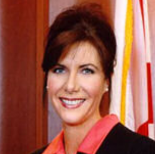

Kelli Wise
Republican | Alabama


Candidate Profile*

Uncontested

BIOGRAPHY
EDUCATION
Candidate did not provide
WORK & MILITARY
Candidate did not provide
AFFILIATIONS
Candidate did not provide
POLITICAL OFFICES HELD
Candidate did not provide
POLITICAL OFFICES SOUGHT
Candidate did not provide
ENDORSEMENTS*
CONSERVATIVE (1)
*Alabama Farmers Federation (ALFA) FARMPAC
OTHER (4)
Alabama Forestry Association ForestPAC
Business Council of Alabama
*Alabama Retail Association PAC
*Manufacture Alabama
SELECTED CONTRIBUTIONS
CONSERVATIVE
GIVEN BY CANDIDATE (2)
State Republican Party Organizations (2022)
WinRed (2020)
RECEIVED BY CANDIDATE (0)
OTHER INFORMATION
Justice Wise has served on the Alabama Supreme Court since 2011. Before that, she was a judge on the Alabama Court of Appeals since 2001.
When announcing her candidacy, Justice Wise said,
"I am honored to serve the people of Alabama. Being a justice on our state’s highest court is a responsibility that I take very seriously, and I have worked to champion justice and the rule of law. In most cases, we are the court of last resort, and I am called upon to rule on issues that impact families, property, livelihoods, and people’s freedom. I think my record shows that I have defended the Constitution, safeguarded our liberties, and provided fair and impartial justice for the litigants who come before the Alabama Supreme Court. I have a conservative judicial philosophy. I don’t legislate from the bench but rather follow the law as it is written because that is the role of the judiciary, anything less amounts to judicial activism. The Constitution created checks and balances between the three branches of government for a reason. As a strict constructionist, it’s my job to look at the facts of each case before us and apply the law fairly. That’s what I do every day."
Justice Wise is a member of the Federalist Society
Notable Cases:
- Justice Wise signed Justice Stuart's special concurrence in Ex parte Jessie Livell Phillips (2018) (accurate conclusion, involved key issues), in which the Alabama Supreme Court held that transferred intent doctrine applies when one of the murdered parties is an unborn child. The court stated that unborn children are recognized as people under Alabama law and that an unborn baby's personhood in criminal proceeding is equal to that of a person who has been born (71).
- Justin Wise signed the majority opinion in Stinnett v. Kennedy (2016) (accurate conclusion, involved key issues), in which the court held that the trial court was wrong to dismiss Stinnett's wrongful death claim (1) because of the precedent of Mack and Hamilton (32).
- Justice Wise joined the majority in Ex parte E.R.G. (2011)(accurate conclusion), which held that the Grandparent Visitation Act was unconstitutional because it could undermine the fundamental right of a fit parent to direct the upbringing of his or her child.
- Justice Wise signed the majority opinion in Mack v. Carmack (2011)(accurate conclusion, involved key issues), holding that viability was irrelevant in fetal wrongful death actions.
- Justice Wise joined the unanimous court in Magers v. Alabama Women's Center Reproductive Alternatives (2020), which held that the petitioner's wrongful death claim should be dismissed because he did not properly argue his case according to Rule 28. The court argued that it is not their role to create arguments on behalf of the petitioner.
- Justice Wise joined the majority opinion in State v. City of Birmingham (2019), holding that the City of Birmingham had "altered" a monument by obstructing the view of its commemorative pedestal. The Court held that municipalities had no free speech or due process rights because they were non-sovereign subdivisions of the state.
- Justice Wise wrote the majority opinion in Battle v. Mobile Infirmary Association (2018), holding that a paragraph of a lower court's protective order had violated the state's rules of discovery outlined in the Alabama Rules of Civil Procedure by making confidential information available to other clients of the plaintiff's counsel's firm.
- Justice Wise signed the court's November 23, 2020 order, which allowed video testimony in all cases where there was "good cause in compelling circumstances."
- Justice Wise signed the court's March 12, 2020 order, which authorized judges to suspend jury trials for the next week amidst the early days of the COVID pandemic.
- Justice Wise signed the majority opinion in Wyeth, Inc. v. Weeks (2013), holding that the brand-name developer of a drug could be held liable for misinformation given about it by a generic manufacturer because of the heavy federal regulations surrounding drugs and the learned-intermediary doctrine
QUESTIONNAIRE
VALUES
I agree with Critical Race Theory (CRT) which asserts that the institutions in the United States are fundamentally racist.
Did not answer
Judeo-Christian values established a framework of morality that is necessary for our system of limited government.
Did not answer
Briefly describe your spiritual beliefs and values.
Did not answer
What types of pro bono work have you done?
Did not answer
ABOUT YOU
Have you ever been convicted of a felony or been penalized in either civil or criminal court for sexual misconduct? If so, please explain.
Did not answer
What education or experience qualifies you to hold the office for which you seek election?
Did not answer
Why should the voters choose you?
Did not answer
I voted in these primaries and general elections:
Did not answer
JUDICIAL PHILOSOPHY
Justices should not interpret the federal and state constitutions as living documents, but should use a textualist and originalist approach to interpretation.
Did not answer
What is the proper use of legislative history in interpreting statutory law?
Did not answer
Which current or past U.S. Supreme Court justice best reflects your judicial philosophy?
Did not answer
How should a court address the balance between public health and individual freedoms in the time of a pandemic?
Did not answer
In light of the case Bostock v. Clayton County, in which the U.S. Supreme Court interpreted the 1964 Civil Rights Act to include a prohibition on sexual-orientation discrimination, which justice’s opinion most closely aligns with your own opinion?
Did not answer
What role (if any) does a judge have in maintaining the separation of church and state?
Did not answer
Religious liberty is at risk in the United States and deserves the highest level of protection in the law.
Did not answer
When should a judge overturn past court decisions?
Did not answer
How should a judge determine which rights are protected by the Constitution even though they are not specifically mentioned?
Did not answer
What legal principles should a court consider when evaluating parents’ objection to their child obtaining medical procedures or drugs designed to affirm the child’s desired gender?
Did not answer
What principles should guide a court’s analysis of whether your state’s constitution gives terminally ill patients a right to assisted suicide?
Did not answer
Would you describe your judicial philosophy as originalist, living constitutionalist, or something else?
Did not answer