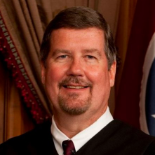

Jeffrey S. Bivins
Non-Partisan | Tennessee




Candidate Profile
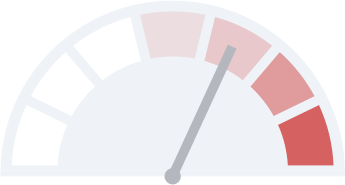
Leans Originalist

BIOGRAPHY
EDUCATION
Candidate did not provide
WORK & MILITARY
Candidate did not provide
AFFILIATIONS
Candidate did not provide
POLITICAL OFFICES HELD
Candidate did not provide
POLITICAL OFFICES SOUGHT
Candidate did not provide
OTHER INFORMATION
Justice Bivins has served on the Tennessee Supreme Court since 2014. He was appointed by Governor Bill Haslam (R). Prior to that, he was a judge on the Tennessee Court of Criminal Appeals since 2011.
Notable Cases:
- State v. Christensen (2017): Wrote majority opinion. Held that a police officer's warrantless entry upon the curtilage of defendant's home (his yard) was not unconstitutional despite defendant's posting of "No Trespassing" signs on his driveway (1). Cited Sneed v. State (Tenn 1968) that the TN Constitution's search and seizure provision is "identical in intent and purpose with the Fourth Amendment" (8). Noted that the state and federal search and seizure provisions both explicitly protect against unreasonable searches of "houses," and noted that the U.S. Supreme Court held in Florida v. Jardines (2012) that the curtilage of a house was also constitutionally protected (9). Cited Jardines that not every entry upon a curtilage was a search (10). Therefore, held that a "knock-and-talk" (i.e. knocking on the property owner's front door) was not inherently a search under the Fourth Amendment (11). The question, therefore, was whether the "No Trespassing" sign amounted to "an express order sufficient to revoke or limit the invitation/license such that a police officer may not legitimately approach the residence via the driveway..." (12). Noted that the answer was mixed among different jurisdictions, but that most have held that a sign by itself was not a sufficient order (13). Held that the test relevant for this case was whether "under the totality of the circumstances, would an objectively reasonable person conclude that entry onto the Defendant's driveway was categorically barred" (16-17). Cited the U.S. Supreme Court's Oliver v. United States (1984) that trespass laws "do not implicate the privacy interests in 'persons, houses, papers, and effects' protected by the Fourth Amendment" (17). Held that the sign was not sufficiently clear to revoke consent because "trespass" implies that the entry would unlawful or wrongful (17). "In short, a homeowner who posts a 'No Trespassing' sign is simply making explicit what the law already recognizes: that persons entering onto another person's land must have a legitimate reason for doing so or risk being held civilly, or perhaps even criminally, liable for trespass" (18).
- State v. Pruitt (2016): Signed Justice Page's majority opinion. Held that the statute at issue in this case was not an ex post facto statute (i.e. a law criminalizing conduct that happened before the law was passed), so defendant's motion to suppress evidence was not well-taken (1). Overruled Miller v. State (Tenn 1979), which held that the scope of Tennessee's ex post facto clause was broader than the U.S. Constitution's scope (1). Explained the federal rationale behind the prevention of ex post facto laws (12). Explained that the U.S. Supreme Court attempted to find the original meaning of the ex post facto clause in Collins v. Youngblood (1990) (14-15). Criticized the Tennessee Supreme Court's decision in Miller v. State (1979) for expanding the interpretation of Tennessee's ex post facto clause without any reasoning aside from a quotation of the state's ex post facto provision (16). Cited Phillips v. Montgomery (Tenn 2014), which said that similarly worded provisions in the state constitution should not be interpreted differently from the federal constitution unless there are "sufficient textual or historical differences, or other grounds for doing so" (17). Held that the Court's lack of analysis in Miller was insufficient to broaden the interpretation of the state's ex post facto provision (18). Briefly discussed the history of the state ex post facto clause (18-19).Concluded that there was no reason for the Tennessee Constitution's ex post facto clause to be interpreted differently from the U.S. Constitution's clause (19).
- Fisher v. Hargett and Lay v. Goins (2020): Signed Justice Clark's majority opinion. Held that the trial court erred in granting injunctive relief allowing all eligible Tennessee voters to be granted absentee ballots due to the COVID-19 pandemic (1-2). Ordered that ballots that had already been issued would be counted (6). Parties conceded that there were two categories of individuals relevant in the suit-- those particularly vulnerable to COVID-19 and those who were not particularly vulnerable (14). Cited that a writ of mandamus was not necessary to ensure that vulnerable individuals would be granted absentee ballots because the State conceded that those individuals were eligible, and public officers are "presumed to discharge their duties in good faith and in accordance with the law" (14-15, quoting West v. Schofield). Said that "likelihood of success on the merits" was the critical element the plaintiffs were required to demonstrate (16). Noted that injunctions mandating action should only be used in exceptional circumstances and ought to be reviewed under an abuse of discretion standard with no presumption that the trial court was correct (16). There were no findings of fact in this case, so no presumption was granted in favor of them (16-17). Held that parties established standing (18). Found that the plaintiffs were arguing for a "hybrid" challenge (rather than as-applied or facial), meaning that plaintiffs were required to meet the high bar for a facial challenge for any individuals beyond themselves (19). Held that the "hybrid" challenge did not limit relief to only named plaintiffs, because even as-applied challenges (the narrowest scope for decisions) do not limit relief to that under the U.S. Supreme Court precedent of Whole Women's Health v. Hellerstedt (2016) (19). Noted that the TN Supreme Court had never ruled on what standard of review voting rights claims were entitled to and that the trial court had adopted the Anderson-Burdick standard from the Sixth Circuit. The TN Supreme Court assumed that Anderson-Burdick was the correct standard without formally ruling on it, since it held that it did not need to be decided (24). Held that absentee voting was a "right" rather than a "privilege" for the sake of Anderson-Burdick because, if no other voting options were available, then absentee voting would become a "right" so as to not violate the TN Constitution's guarantee of a right to vote. Noted that in-person voting was the standard (24-25). Cited a South Carolina case for support which held "that the 'privilege' to vote absentee 'so intimately [a]ffects the fundamental right to vote' as to require the court to determine that the plaintiffs’ challenge is to be examined under a 'normative constitutional rights framework.'" (25). Held that the burden on the right to vote for these individuals was "moderate" because they faced significantly less risk of contracting COVID-19 from voting in person, as opposed to the other category of individuals, and the State had taken steps to make voting in-person safer (26-27). Held that the TN Constitution and statutes indicated that the State had an interest and was empowers to enact laws combating voter fraud. These were able to be prophylactic measures to prevent fraud so long as those measures did not, in the words of Chief Justice John Roberts, "overstep by infringing on qualified citizens’ right to suffrage" (27-28, quoting Roberts' concurrence in Little v. Reclaim Idaho (2020). The Court also found regarding the State's interest in fiscal responsibility and feasibility that, "Once again, we are constrained by the Constitution’s delegation to the Legislature of the power to regulate the conduct of our elections, which certainly includes within its scope the interest in fiscal responsibility and efficient conduct of the elections" (28-29). The Court continued, "These policy choices will be judged by history and by the citizens of Tennessee. We, however, properly may not and will not judge the relative merits of them, regardless of our own views. To do so would be to exceed the proper scope of our role as jurists." Concluded that plaintiffs did not prove they were likely to succeed on the merits of their case because the State's interests were sufficient to justify the moderate burden place on their right to vote (29-30).
- West v. Schofield (2017): Wrote majority opinion. Held that Tennessee's one-drug injection protocol did not violate the U.S. or Tennessee Constitutions protections against cruel and unusual punishments. The Court extensively applied the federal Eighth Amendment precedents of Glossip and Baze (2-21). The Court preliminarily adopted the federal tests from the federal precedent (22).
Info from Other Sources:
- Justice Bivins has spoken at a number of Federalist Society events.
- Justice Bivins spoke to students at the Regent University School of Law regarding the importance of judicial independence in a politically polarized nation. An article about the event stated that Justice Bivins, "discussed the judicial branch and the responsibility of 'interpreting laws in good faith.' He spoke about the importance of checks and balances and how this system, designed to ensure a fair proportion of power, helps no one branch attain too much power. The idea of too much power is also one reason he warns against stacking the court. [Justice Bivins] gave an example of how judicial independence works as it should when constitutional prudence is applied. He shared how he, a Republican, and a fellow justice, a Democrat—whom he declared a dear friend—found common ground in the law and their friendship. 'Out of the 250-plus opinions together, we only disagreed on seven cases.'"
QUESTIONNAIRE
VALUES
I agree with Critical Race Theory (CRT) which asserts that the institutions in the United States are fundamentally racist.
Did not answer
Judeo-Christian values established a framework of morality that is necessary for our system of limited government.
Did not answer
Briefly describe your spiritual beliefs and values.
Did not answer
What types of pro bono work have you done?
Did not answer
ABOUT YOU
Have you ever been convicted of a felony or been penalized in either civil or criminal court for sexual misconduct? If so, please explain.
Did not answer
What education or experience qualifies you to hold the office for which you seek election?
Did not answer
Why should the voters choose you?
Did not answer
I voted in these primaries and general elections:
Did not answer
JUDICIAL PHILOSOPHY
Justices should not interpret the federal and state constitutions as living documents, but should use a textualist and originalist approach to interpretation.
Did not answer
What is the proper use of legislative history in interpreting statutory law?
Did not answer
Which current or past U.S. Supreme Court justice best reflects your judicial philosophy?
Did not answer
How should a court address the balance between public health and individual freedoms in the time of a pandemic?
Did not answer
In light of the case Bostock v. Clayton County, in which the U.S. Supreme Court interpreted the 1964 Civil Rights Act to include a prohibition on sexual-orientation discrimination, which justice’s opinion most closely aligns with your own opinion?
Did not answer
What role (if any) does a judge have in maintaining the separation of church and state?
Did not answer
Religious liberty is at risk in the United States and deserves the highest level of protection in the law.
Did not answer
When should a judge overturn past court decisions?
Did not answer
How should a judge determine which rights are protected by the Constitution even though they are not specifically mentioned?
Did not answer
What legal principles should a court consider when evaluating parents’ objection to their child obtaining medical procedures or drugs designed to affirm the child’s desired gender?
Did not answer
What principles should guide a court’s analysis of whether your state’s constitution gives terminally ill patients a right to assisted suicide?
Did not answer
Would you describe your judicial philosophy as originalist, living constitutionalist, or something else?
Did not answer