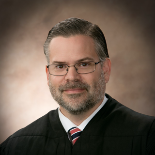

Caleb Stegall
Non-Partisan | Kansas




Candidate Profile*

Proven Originalist

BIOGRAPHY
EDUCATION
Candidate did not provide
WORK & MILITARY
Candidate did not provide
AFFILIATIONS
Candidate did not provide
POLITICAL OFFICES HELD
Candidate did not provide
POLITICAL OFFICES SOUGHT
Candidate did not provide
ENDORSEMENTS*
CONSERVATIVE (1)
*Judge Voter Guide
OTHER INFORMATION
Justice Caleb Stegall was appointed in 2014 by Governor Sam Brownback (R) to fill a vacancy in the Kansas Supreme Court. Prior he was on the Kansas Court of Appeals. Ballotpedia gives him the “confidence score of Strong Republican.” He clerked for Deanell Tacha who was nominated by Ronald Reagan to serve on the United States Court of Appeals for the 10th Circuit.
Notable Cases:
- In Tillman v Goodpasture, Stegall wrote concurrence/dissent. Agreed with the majority's conclusion that Kansas law did not allow wrongful-birth claims (26). Argued that the majority should have reached this conclusion by overruling the KS Supreme Court case that allowed wrongful-birth claims (20). Called wrongful-birth claims "'utterly revolting'...discrimination" (23). Tied the concept of wrongful birth to eugenics (24, 26). Quoted a case that called wrongful birth "lethal nonsense" (26). Called the opportunity to have an abortion an "opportunity to take a life" (27). Agreed with the dissent that wrongful birth was not a new cause of action (26), but questioned whether the age of the wrongful-birth was relevant to the case (27).
- In Hodes & Nauser, MDS, P.A. v. Schmidt, Justice Stegall wrote the dissent. Argued that this case was not about the policy of abortion but about the structure of KS' republican form of government (115). Argued this was the most "significant and far-reaching decision this court has ever made" because it fundamentally altered the structure of government to empower the state and to thereby grant an artificial regulatory reprieve to abortion (115). Argued the majority misrepresented the original public meaning of Section 1 as being mired in prejudice (115). Argued majority's representation of the framers' thoughts on abortion was contradictory (117-118). Argued that abortion restrictions are not relics of a patriarchal society, but are a longstanding feature of KS law, and argued that "ban on dismembering a living human being in utero is not inherently sexist and discriminatory" (119). Argued that the majority pulled a sleight of hand by simultaneously claiming that legislative intent was the foundation of interpretation, while also arguing that the drafters of the KS Const were corrupted by paternalism and prejudice (123). Argued the majority engaged in living constitutionalism, though it did not use the name (123). Said that, "My commitment is to the fixed meaning of our constitutional text as it was originally understood by the people writing, reading, and ratifying that text" (124). Emphasized that interpretation can be difficult, even coming from an original public meaning lens (126). Advocated for originalism and original public meaning (124-130). Argued the majority's view of the law as being "organic" and capable of changing with the times was incorrect, despite having support in KS caselaw, because such decisions often cannot be properly explained (130-131). Argued that " The majority misunderstands and misuses history; bolsters its rejection of Kansas law with factually unsupported allegations of prejudice; ignores even its own claim to be pursuing the 'drafters' intent' as the 'polestar' of constitutional interpretation (slip op. at 17); and in the end, can do no better than to fall back on federal substantive due process jurisprudence" (131). Argued the majority mistakenly read Locke through a voluntarist lens, which would lend support to a government which would step in to remove any individual's limiting conditions-- argued instead for the traditional "commonwealth lens" (132-133). Argued that judges must be careful to not put too much stock into their historical research skills (138-139). Cited Madison's contrast of European "charters of liberty granted by power" and the American "charters of power granted by liberty" (140). Cited Georgetown Professor Randy Barnett that the understanding of the founders was essentially "first comes rights, then comes government" (140). Argued that this view was later inverted during the early 19th century to see states as possessing European-style absolute sovereignty-- violating natural rights in the name of "self-determination" (141-145) Argued that one of Lincoln's most pivotal contributions was to point out the switch that had taken place fomented by thinkers like Roger Taney, Stephen Douglas, and John C. Calhoun to discredit the language of the founding into "glittering generality" rather than the true principles that government was instituted among men to secure their rights, and not the other way (145-151). Said that the original understanding was prevalent at the Wyandotte convention, which the majority cited so frequently, and that this understanding held Section 1 to be a *structural* statement rather than a grant of civil rights (156,159). Argued Section 1 was intended to be a statement granting limited authority to the state (159). Argued the majority's holding was inconsistent with the original public meaning of Section 1 (163). Argued that the KS courts had traditionally understood Section 1 as a structural statement (167-173). Argued Section 1 really required "rational basis with bite," in that every act of the government must be rationally related to the good of the commonwealth (185). Said the majority strawmanned his argument (187). Argued the case should have been remanded to apply the correct legal standard (187-188). Argued the law at issue in this case may have likely passed the "rational basis with bite" test (189). "It is the right to self-government properly understood—and the constituent political community it establishes—which today's majority has taken from Kansans" (191). Cited Tennessee SC Justice Barker that declaring abortion a fundamental right denies the people the opportunity to rule themselves and weigh competing interests (192). Argued that "the Constitution announces and defines boundaries, not values" and that is the court's job to maintain those boundaries (194). Cited that when judges identify fundamental substantive values, they are liable to really be discovering their own values (195). Argued that the majority's decision turned the fundamental structure of KS' government on its head (198).
- In Butler v. Shawnee Mission School District Board of Education, Stegall joined in Luckert’s dissent. Found the prior court should have dismissed the case as it lacked jurisdiction to consider the constitutional challenge. Found the district court gave an advisory opinion thus the appeal lacks jurisdiction. Held attorney general intervening did not give right to decide constitutionality because appeals an issue that would not change outcome of prior decision and is “purely an advisory opinion.” Held precedent in Ternes v. Galichia recognized the court lacks jurisdiction where the appellant was an intervenor.
- In In the Matter of the Parentage of M.F., Stegall wrote dissent. Argued that, under any accepted mode of statutory interpretation, the notion that the plain language of the Kansas Parentage Act meant a person not biologically related to a child could become a biological parent was untenable, as he explained in a dissent in In re Adoption of T.M.M.H (2019) (41). Argued that one can only acknowledge a fact that already exists, therefore one cannot "acknowledge" a biological parental relationship that does not exist in reality (42). Argued that the majority's ruling means that "saying makes it so," which is no rule at all (42). Argued that once the majority arrived at its "declared parentage" rule, the rest of the opinion was sheer policymaking (44).
- In State v. Thurber, Stegall joined Biles' majority opinion. Affirmed the defendant's murder conviction (6). Remanded the case for the district court to apply new legal standards for whether the defendant was intellectually disabled (7). Acknowledged some errors in the trial, but held that these errors were harmless (94-5). Struck down part of a state law that contradicted SCOTUS's most recent holdings on intellectual disability (112, 115).
Other Sources:
- Retweeted Justice Wall–”Great discussion about the role of judges in our democracy, a judge’s duty to decide cases fairly, impartially, and free from political influence.
Judge Voter Guide gave 2 Stars and voted to "replace."
QUESTIONNAIRE
VALUES
I agree with Critical Race Theory (CRT) which asserts that the institutions in the United States are fundamentally racist.
Did not answer
Judeo-Christian values established a framework of morality that is necessary for our system of limited government.
Did not answer
Briefly describe your spiritual beliefs and values.
Did not answer
What types of pro bono work have you done?
Did not answer
ABOUT YOU
Have you ever been convicted of a felony or been penalized in either civil or criminal court for sexual misconduct? If so, please explain.
Did not answer
What education or experience qualifies you to hold the office for which you seek election?
Did not answer
Why should the voters choose you?
Did not answer
I voted in these primaries and general elections:
Did not answer
JUDICIAL PHILOSOPHY
Justices should not interpret the federal and state constitutions as living documents, but should use a textualist and originalist approach to interpretation.
Did not answer
What is the proper use of legislative history in interpreting statutory law?
Did not answer
Which current or past U.S. Supreme Court justice best reflects your judicial philosophy?
Did not answer
How should a court address the balance between public health and individual freedoms in the time of a pandemic?
Did not answer
In light of the case Bostock v. Clayton County, in which the U.S. Supreme Court interpreted the 1964 Civil Rights Act to include a prohibition on sexual-orientation discrimination, which justice’s opinion most closely aligns with your own opinion?
Did not answer
What role (if any) does a judge have in maintaining the separation of church and state?
Did not answer
Religious liberty is at risk in the United States and deserves the highest level of protection in the law.
Did not answer
When should a judge overturn past court decisions?
Did not answer
How should a judge determine which rights are protected by the Constitution even though they are not specifically mentioned?
Did not answer
What legal principles should a court consider when evaluating parents’ objection to their child obtaining medical procedures or drugs designed to affirm the child’s desired gender?
Did not answer
What principles should guide a court’s analysis of whether your state’s constitution gives terminally ill patients a right to assisted suicide?
Did not answer
Would you describe your judicial philosophy as originalist, living constitutionalist, or something else?
Did not answer