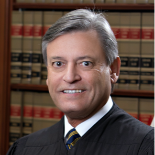

Jorge Labarga
Non-Partisan | Florida



Candidate Profile*

Activist

BIOGRAPHY
EDUCATION
Candidate did not provide
WORK & MILITARY
Candidate did not provide
AFFILIATIONS
Candidate did not provide
POLITICAL OFFICES HELD
Candidate did not provide
POLITICAL OFFICES SOUGHT
Candidate did not provide
ENDORSEMENTS*
CONSERVATIVE (1)
*Judge Voter Guide
LIBERAL (1)
*Palm Beach County Human Rights Council Voters Alliance
OTHER INFORMATION
Justice Labarga was appointed 2009 by Governor Charlie Crist n December 2008 Justice Labarga was appointed by Governor Charlie Crist to the Fourth District Court of Appeal. He was the Chief Justice of Florida from 2014-2018.
Notable Cases:
- Advisory Opinion to the Governor Re: Implementation of Amendment 4, The Voting Restoration Amendment (2020): Justice Larbarga wrote a concurrence in result and a dissent in part. He argued that the court was wrong to advocate the "supremacy-of-text principle" (28) Argued textualism is not helpful where the text is not developed enough for its meaning to be discernable (34-35) He said that originalism is problematic because it can disapprove of factors which Labarga argued may be helpful or dispositive in interpreting a statute (29). Instead, Labarga argued that legislative intent should be sought out (30).
- Scott v. Williams (2013): Justice Labarga wrote the majority opinion, which held that the state did not impair its current employees' contract rights when it changed their retirement system’s future requirements and benefits (3).
- Lawrence v. State (2020): Justice Labarga wrote a dissent, in which he argued that the majority's decision that proportionality review was not required in capital punishment cases threw out a 50-year-old tradition of jurisprudence (18-19). Labarga supported his argument that proportionality was so fundamental to direct appellate review of death penalty cases by referencing Fla. R. App. P. 9.142(a)(5), which mandated such review (20). Justice Labarga said that the majority was wrong to hold that Supreme Court precedent forbid proportionality review because Pulley v. Harris (1984) merely held that proportionality review was not required (23). Justice Labarga recommended that the court maintain its proportionality requirement so as not to become an outlier among other states (28).
- Phillips vs. State (2020): Justice Labarga wrote a dissent. Argued that failing to apply Hall v. Florida’s (2014) holding retroactively left individuals who would otherwise be eligible for its protections vulnerable, despite preserved claims of their intellectual disability (25). He argued that that arbitrary result undermines the prohibition on executing the intellectually disabled (25). Labarga said that Hall was not merely a procedural evolution in the law because it expanded eligibility for relief to new classes of individuals (26).
Judge Voter Guide gave 3 Stars and voted to "retain."
QUESTIONNAIRE
VALUES
I agree with Critical Race Theory (CRT) which asserts that the institutions in the United States are fundamentally racist.
Did not answer
Judeo-Christian values established a framework of morality that is necessary for our system of limited government.
Did not answer
Briefly describe your spiritual beliefs and values.
Did not answer
What types of pro bono work have you done?
Did not answer
ABOUT YOU
Have you ever been convicted of a felony or been penalized in either civil or criminal court for sexual misconduct? If so, please explain.
Did not answer
What education or experience qualifies you to hold the office for which you seek election?
Did not answer
Why should the voters choose you?
Did not answer
I voted in these primaries and general elections:
Did not answer
JUDICIAL PHILOSOPHY
Justices should not interpret the federal and state constitutions as living documents, but should use a textualist and originalist approach to interpretation.
Did not answer
What is the proper use of legislative history in interpreting statutory law?
Did not answer
Which current or past U.S. Supreme Court justice best reflects your judicial philosophy?
Did not answer
How should a court address the balance between public health and individual freedoms in the time of a pandemic?
Did not answer
In light of the case Bostock v. Clayton County, in which the U.S. Supreme Court interpreted the 1964 Civil Rights Act to include a prohibition on sexual-orientation discrimination, which justice’s opinion most closely aligns with your own opinion?
Did not answer
What role (if any) does a judge have in maintaining the separation of church and state?
Did not answer
Religious liberty is at risk in the United States and deserves the highest level of protection in the law.
Did not answer
When should a judge overturn past court decisions?
Did not answer
How should a judge determine which rights are protected by the Constitution even though they are not specifically mentioned?
Did not answer
What legal principles should a court consider when evaluating parents’ objection to their child obtaining medical procedures or drugs designed to affirm the child’s desired gender?
Did not answer
What principles should guide a court’s analysis of whether your state’s constitution gives terminally ill patients a right to assisted suicide?
Did not answer
Would you describe your judicial philosophy as originalist, living constitutionalist, or something else?
Did not answer