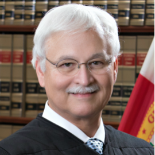

Ricky Polston
Non-Partisan | Florida



Candidate Profile*

Originalist

BIOGRAPHY
EDUCATION
Candidate did not provide
WORK & MILITARY
Candidate did not provide
AFFILIATIONS
Candidate did not provide
POLITICAL OFFICES HELD
Candidate did not provide
POLITICAL OFFICES SOUGHT
Candidate did not provide
ENDORSEMENTS*
CONSERVATIVE (1)
*Judge Voter Guide
OTHER INFORMATION
Justice Polston was appointed to the Florida Supreme Court in 2008. He served as Chief Justice from 2012-2014.
Notable Cases:
- Advisory Opinion to the Governor Re: Implementation of Amendment 4, The Voting Restoration Amendment (2020): Justice Polston signed the per curiam majority opinion, which held that an amendment restoring voting rights to felons upon completion of "all terms of sentence" required the fulfillment of legal financial obligations (LFOs) (1-2). The court held that legislative intent was not a solid basis for interpretation; instead, it said that the statute should be construed according to its plain meaning (14). The court referred to the canons of interpretation (18). It also noted that similar language had been interpreted accordingly in other jurisdictions (21).
- Lawrence v. State (2020): Justice Polston signed the per curiam majority opinion, which held that "the conformity clause of article I, section 17 of the Florida Constitution [forbid] [the] Court from analyzing death sentences for comparative proportionality in the absence of a statute establishing that review" (1-2). The court reasoned that the conformity clause requires that Florida’s prohibitions against cruel and unusual punishments be interpreted in line with the U.S. Supreme Court’s interpretation of the Eighth Amendment (7). The Supreme Court held that proportionality review was not mandatory in Pulley v. Harris (1984) (7). As a result, the court overturned its precedent of Yacob v. State (2014), which had read a proportionality requirement into Florida law (8), arguing that the court cannot mandate review where there is no statutory requirement (11). Footnote 5 emphasized that the court's duty was to follow the constitution, rather than to create good policy (13). The court took into account whether stare decisis should lead it to uphold Yacob (12).
- League of Women Voters of Florida v. Scott (2017): Justice Polston signed the per curiam majority opinion. The Court dismissed a petition to restrain the governor’s future conduct because it was not within the court’s authority to do so (1-2). The court declined the option (laid out in the dissent) to expand the court’s historical use of quo warranto in the interests of “the overarching principles of our democracy” (12).
- Public Defender, Eleventh Judicial Circuit of Florida, et al. v. State of Florida (2013): Justice Polston wrote a concurrence in part and dissent in part. That opinion agreed with the majority that 1) the legislature can constitutionally restrain the courts from removing public defenders based only on the defenders' excessive workloads, 2) the constitution requires the courts to grant public defenders' requests to be removed from cases that the public defenders are too busy to provide effective counsel for, and 3) the state has standing to oppose defenders' motions to be removed from cases (46). The dissenting part of the opinion argued that the courts should only remove public defenders from particular cases where the defenders have shown that they cannot provide adequate counsel (46). Justice Polston’s opinion encouraged the court to avoid a sweeping policy about groups of cases when it was possible to protect defendants' constitutional rights on a case-by-case basis.
- In re: Amendment to Rule Regulation the Florida Bar 6-10.3 (2021): Justice Polston signed the per curiam majority opinion, which held that a Florida Bar rule setting a minimum requirement for diverse continuing legal education faculty violated the precedent of Grutter v. Bollinger (2003) and Regents of the University of California v. Bakke (1978) by instituting a quota based on characteristics such as "race, ethnicity, gender, sexual orientation, gender identity, disability, and multiculturalism" (1). The court also amended rule 6-10.3(d) of the Rules Regulating the Florida Bar to prohibit such requirements and ordered the Bar to take the measures necessary to ensure compliance with the amended rule (2-3). Court allowed 74 days for public comment on the updated rule (3)
- In Re: Amendments to the Florida Evidence Code (2019): Justice Polston signed the per curiam majority opinion. The court adopted the Daubert amendments to the state evidence code (1), which provided that "the trial judge must ensure that any and all scientific testimony or evidence admitted is not only relevant, but reliable" among other provisions (6) and the Frye standard was replaced (2). Justice Luck's dissent argued that the majority did not follow the proper procedure for adopting procedural rules (19).
Judge Voter Guide gave 4 Stars and voted to "retain."
QUESTIONNAIRE
VALUES
I agree with Critical Race Theory (CRT) which asserts that the institutions in the United States are fundamentally racist.
Did not answer
Judeo-Christian values established a framework of morality that is necessary for our system of limited government.
Did not answer
Briefly describe your spiritual beliefs and values.
Did not answer
What types of pro bono work have you done?
Did not answer
ABOUT YOU
Have you ever been convicted of a felony or been penalized in either civil or criminal court for sexual misconduct? If so, please explain.
Did not answer
What education or experience qualifies you to hold the office for which you seek election?
Did not answer
Why should the voters choose you?
Did not answer
I voted in these primaries and general elections:
Did not answer
JUDICIAL PHILOSOPHY
Justices should not interpret the federal and state constitutions as living documents, but should use a textualist and originalist approach to interpretation.
Did not answer
What is the proper use of legislative history in interpreting statutory law?
Did not answer
Which current or past U.S. Supreme Court justice best reflects your judicial philosophy?
Did not answer
How should a court address the balance between public health and individual freedoms in the time of a pandemic?
Did not answer
In light of the case Bostock v. Clayton County, in which the U.S. Supreme Court interpreted the 1964 Civil Rights Act to include a prohibition on sexual-orientation discrimination, which justice’s opinion most closely aligns with your own opinion?
Did not answer
What role (if any) does a judge have in maintaining the separation of church and state?
Did not answer
Religious liberty is at risk in the United States and deserves the highest level of protection in the law.
Did not answer
When should a judge overturn past court decisions?
Did not answer
How should a judge determine which rights are protected by the Constitution even though they are not specifically mentioned?
Did not answer
What legal principles should a court consider when evaluating parents’ objection to their child obtaining medical procedures or drugs designed to affirm the child’s desired gender?
Did not answer
What principles should guide a court’s analysis of whether your state’s constitution gives terminally ill patients a right to assisted suicide?
Did not answer
Would you describe your judicial philosophy as originalist, living constitutionalist, or something else?
Did not answer