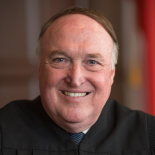

John M. Tyson
Republican | North Carolina





Candidate Profile*

Originalist

BIOGRAPHY
EDUCATION
University of Virginia School of Law, Charlottesville, Va., LLM in Judicial rocess, 2004
Campbell University School of Law, Buies Creek NC, Juris Doctor Cum laude, 1979
Duke University, Fuqua School of Business, Durham NC, MBA, 1988
University of North Carolina - Wilmington, Wilmington, NC, Bachelor of Arts, 1974
WORK & MILITARY
Please see www. judgejohntyson.com for full list
North Carolina Dispute Resolution Commission, Vice Chair, 2017-present
AFFILIATIONS
Campbell University Norman Adrain Wiggins School of LAw, Adj Professor of Law, Elon University School of Law
Adj Professor of Law, First Presbyterian Church, past Chair of the Board of Deacons
Campbell University, Presidential Board of Advisers, American Red Cross
POLITICAL OFFICES HELD
Judge of North Carolina Court of Appeals, 2001-2009, 2015-present
Vice Chair- North Carolina Dispute Resolution Commission, 2017-Present
Chair - North Carolina State Ethics Commission, 2012-2014
Chair- Cumberland Soil and Water Conservation District, 1992-1996
Chair-Cumberland County Joint Planning Board, 1993-2001
Commissioner - North Carolina Property Tax Commission, 1997-1999
POLITICAL OFFICES SOUGHT
Supreme Court of North Carolina, 2004
Judge of the Superior Court, 2012
ENDORSEMENTS*
CONSERVATIVE (8)
Dr. James Dobson
Mark Meadows
North Carolina Right to Life PAC
North Carolina Values Coalition
Durham County Republican Party
OTHER (6)
Patrick McHenry
*North Carolina Fraternal Order of Police
Steve Troxler
*North Carolina Association of Defense Attorneys
John Szoka
REPORTED BY CANDIDATE (4)
My candidacy for re-election is endorsed by more than a dozen retired Chief and Associate Justices on the Supreme and Judges of the Court of Appeals, who worked with me for many years, and who have first-hand experience of my knowledge, skills, judicial temperament, and work ethic.
My candidacy for re-election has also been endorsed by numerous Sheriffs and law enforcement groups from across North Carolina, and by current and former U.S.Senators, Congressmen, and North Carolina Legislators.
My candidacy has been endorsed by dozens of current and former Federal and North Carolina Senators, Congressmen, and Legislators
The NC Defense Fund and NC Values have also endorsed my re-election. Please visit www.judgejohntyson.com for additional endorsements.
SELECTED CONTRIBUTIONS
CONSERVATIVE
GIVEN BY CANDIDATE (1)
State Republican Party Organizations (2006)
RECEIVED BY CANDIDATE (0)
OTHER INFORMATION
Curriculum Vita with list of his publications.
Judge Tyson has served on the North Carolina Court of Appeals since 2015.
Notable Cases:
- In re: J.M. & N.M. (2021): Signed Judge Wood's majority opinion. Reversed and remanded a permanency planning order eliminating reunification from the children’s permanent plan after it was appealed by respondent mother and father. A petition was filed by the Catawba County Department of Social Services (DSS) finding daughter Nellie to be abused, neglected and dependent and son Jon to be neglected and dependent (3).The trial court ordered a primary plan of reunification and a secondary plan of adoption (7). In subsequent appearances, neither respondent told the court under oath how Nellie’s injuries had happened (8). In 2020, the court abandoned reunification efforts, since “there can be no mitigation of risk of harm to the children” with neither respondent explaining how the injuries happened (9-10). The Court’s standard is whether the lower court’s findings were based on credible evidence, whether the facts supported the court’s conclusion, and whether the lower court abused its discretion. (10). Held that the trial court erred when it ceased reunification efforts (11, 17). Reunification wherever possible is the rule of juvenile court (12). The evidence in the record supported that respondents were complying with their case plans, which they had undertaken prior to adjudication (13). The trial court made no findings that the mother could not take care of her children, and respondent mother stated under oath that she did not know how Nellie had been injured because she had not seen what happened (14-16). As a result, a finding that reunification efforts would be unsuccessful with regard to the mother was contrary to the evidence presented (15). Held that no evidence supported the conclusion that father continued to act inappropriately after the children left his care; instead, the father completed all of his abuser program and domestic violence classes (17-18). Held that the evidence in the record did not support that either of the parents were “protecting” the other (19). Rejected respondents’ claim that the trial court erred by failing to advise them of their right to file a motion to review the visitation plan (20). Held that the trial court erred in concluding DSS made “reasonable efforts” to reunify and eliminate the need for placement of the children because DSS did not investigate potential causes of Nellie’s injuries by interviewing respondents’ two older children (21-22). Held that trial court failed to make findings regarding respondent-father’s constitutionally protected parental status, and cited that any severance of parents rights must be supported by “clear and convincing evidence” according to In re D.A. (2016) (25).
-
Cooper v. Berger (2019): Signed Inman's majority opinion. Held that the General Assembly did not violate the NC Const.by passing a budget apportioning federal block grant funds against the governor's preferred manner (2). Held that the court had jurisdiction because the interlocutory order was final as to the governor's challenge to the block grant appropriations (7). Analyzed the history and purpose of federal aid and block grants (9-17). Held that block grants were within the state treasury because . Held that the Gardner precedent did not necessarily exclude sources of income other than state-levied taxes, fines, etc from the ambit of "public funds" and it did not involve federal funds (23-24). Concluded Gardner was not controlling (25). Held that the federal block grant statutes did not show an intent for executive control of the funds (26). Held that none of the statutes awarded the funds directly to the governor or a state agency (28). Held that block grants were not "custodial funds" under the NC Const. (30).
-
Cooper v. Berger (2017): Signed per curiam majority opinion. Affirmed lower court's order upholding the constitutionality of two laws expanding senatorial advice and consent requirements to principal State department appointees created by statute and holding that such requirements did not violate separation of powers (1-4). Cited the 4th Circuit that there is no absolute bright line for separation of powers issues (9). Cited NC Supreme Court precedent of McCrory that separation of powers cases are determined case-by-case (10). Held that McCrory was distinguishable because it permitted the General Assembly to appoint constitutional officers, rather than the governor (12). Held that Session Law 2016-126 permitted the governor to appoint officers with the advice & consent of the senate (12). Cited McCrory's holding that the governor did not have exclusive authority to appoint “statutory officers to administrative commissions" (12). Cited that the NC Constitution was a limitation of power, and not a grant, and that the remaining power belonged to the people represented through the General Assembly (13). Concluded that, while Article III, Section 5(8) granted the governor exclusive control to appoint constitutional officers, the governor failed to show that he had the exclusive power to appoint statutory officers (13). Concluded that the laws did not violate separation of powers (13-14).
-
State v. Bishop (2016): Wrote majority opinion. Upheld defendant's conviction for cyberbullying (1). Defendant argued that N.C. Gen. Stat. § 14-458.1(a)(1)(d) was unconstitutionally overbroad and vague (5). Court held that individuals may challenge a law for overbreadth even if constitutional as applied to them (7). Cited that laws are overbroad if they criminalize constitutionally protected conduct (8). Cited SCOTUS that laws which appear to contain content-based regulations may be deemed content-neutral and permissible if motivated by a permissible content-neutral purpose (10). Held that the text of the cyber-bullying statute made it clear that defendant was not prosecuted for the content of his comments (10). Held that the regulation of the law on speech was incidental, and that the law was aimed at preventing the conduct of harassment (11-12). Argued that the law did not suffer from the same flaw as a similar New York law because it criminalized the release in certain kinds of information, rather than speech (13-14). Concluded that the statute was not void for being overbroad (14). Held that an as-applied vagueness challenge was not preserved (15). Held that there was no support that this was an ""exceptional circumstance"" that would enable the court to use Rule 2 of the North Carolina Rules of Appellate Procedure “[t]o prevent manifest injustice to a party” (16). Held that defendant failed to preserve his motion for insufficient evidence for appeal (17).
Tyson's campaign website states that "Judge Tyson maintains a conservative judicial philosophy that protects individual freedoms, self-defense, private property, parental and rights of the unborn, and the separation of powers where the legislature makes policy."
QUESTIONNAIRE
VALUES
I agree with Critical Race Theory (CRT) which asserts that the institutions in the United States are fundamentally racist.
Strongly Disagree
Judeo-Christian values established a framework of morality that is necessary for our system of limited government.
Strongly Agree
Briefly describe your spiritual beliefs and values.
I am a confessed sinner whose eternal life is redeemed by profession of faith in my Lord and Savior, Jesus Christ. I was raised in a bible-believing family and church and surrounded by a family who openly professes and practices their faith. I believe in the power of prayer and have seen the positive differences when prayers are answered. I have witnessed miracles occur in my own life and in the lives of my family and others close to me, which can only be explained by God’s intervention. The family is the primary and fundamental unit of society and must be protected. I believe in the differences between right and wrong, and in personal responsibility, each person must accept and bear for their behaviors and decisions. While we should keep and hold others in our prayers, their chosen burdens should not be unwillingly imposed upon nor shifted to other family members or society at large. An individual responsibility and duty exists to accept, bear, and resolve those consequences from choices made, hopefully with faith and prayers. Please see www.judgejohntyson.com.
What types of pro bono work have you done?
I mentor young folks through youth advocacy and similar intern and training programs. I regularly visit high schools, undergraduate and law schools. My chambers offered numerous internships to high school, undergraduate, and law students, regardless of religion, national origin, race, or sex throughout all years. These individuals are provided opportunities to improve their legal research, writing, and advocacy skills and become better attorneys. I frequently speak to high school classes, the community, judge student mock trials and moot court competitions, and speak to civic groups about the role of the courts. My community involvement and volunteer service are listed at www.judgejohntyson.com Professional Organizations: Certified Appellate Mediator, North Carolina Court of Appeals, 2003–present. Certified United States District Court Mediator (E.D.N.C.), 1993–present (Inactive); Certified Mediator by the Dispute Resolution Commission for North Carolina Superior Court Mediation, 1992–present- Current elected Vice Chair; American Arbitration Association, member of Panel of Arbitrators, 1991–present; American Bar Association, 1980–1992; 2012-present. North Carolina Bar Association, 1980–present; Cumberland County and 12th & 14th Judicial District Bar Assoc., 1980–present Fayetteville - Cumberland County Chamber of Commerce; 1993 to Present North Carolina Farm Bureau; 1985 - Present International Council of Shopping Centers (ICSC), 1982–present Academic and Scholarly Memberships: The United States Supreme Court Historical Society, 2001-present Campbell University, Presidential Board of Advisors, 2003–present; Campbell University National Alumni Association, 1979-present, (President,1999-2001), Executive Board of Directors, 1999–present; Campbell University Norman Adrian Wiggins School of Law Alumni Association, 1979 -present President,1984-1986; The Federalist Society, 2001–present; University of Virginia Law Alumni Association, 2002–present; Duke University Alumni Association, 1988–present; University of North Carolina-Wilmington Alumni Association, 1974–present; Civic & Charitable Memberships: North Carolina Republican Party; Fayetteville Kiwanis Club; Kiwanis International; Honorary Order of Kentucky Colonels; American Red Cross; First Presbyterian Church, Fayetteville, NC; Ducks Unlimited, Inc. (Life Member); National Rifle Association (NRA) –Endowment Life Member, Legion of Honor, Millennium Honor Roll,
ABOUT YOU
What education or experience qualifies you to hold the office for which you seek election?
Juris Doctor (J.D.) with honors. Campbell University School of Law (1979--Member of the Charter Class); Master of Laws in Judicial Process (LL.M.) University of Virginia School of Law (2004l; Master of Business Administration (M.B.A.) from Duke University (1988); Bachelor of Arts (B.A.) in English and Education; The University of North Carolina- Wilmington (1974). Bar Admissions: Supreme Court of the United States Bar, 1983; United States Court of Appeals Bar (Fourth Circuit), 1980; United States District Court Bar (W.D.N.C., 1980) and (E.D.N.C., 1997); North Carolina State Bar, 1980; Virginia State Bar, 1981;
Why should the voters choose you?
I am seeking re-election to seat 10 that I currently hold on the Court of Appeals and served as an elected Judge on the North Carolina Court of Appeals from 2001 until 2009. Upon completion of that term, I was appointed by the Governor to serve as a Recall Judge on the North Carolina Court of Appeals, and as an Emergency Superior Court Judge into 2013. I served as Chair of the State Ethics Commission from 2013-4. I won re-election to the Court of Appeals in 2014 and served continuously since. Elected Vice-Chair of the North Carolina Dispute Resolution Commission. NC State Bar Board Certified Specialist -Real Property; AV Pre-Eminent highest peer review rating in both ethics and knowledge of law; Martindale Hubbell. I have ruled on over 5,000 appeals and motions and have written over 2,500 opinions with 98% affirmed or left undisturbed by the Supreme Court of North Carolina. While court policy allows 90 days for opinions to be filed, I averaged filing my opinions within 30 days, using taxpayers’ time and resources judiciously.
I voted in these primaries and general elections:
2012 Republican Primary 2012 General Election 2014 Republican Primary 2014 General Election 2016 Republican Primary 2016 General Election 2018 Republican Primary 2018 General Election 2020 Republican Primary 2020 General Election
JUDICIAL PHILOSOPHY
Justices should not interpret the federal and state constitutions as living documents, but should use a textualist and originalist approach to interpretation.
Agree
The Constitution “says what it means and means what it says.” Judges should not legislate from the bench or impose their personal preferences on policy. Fairness and Impartiality are expected of all Judges. Please see: www.judgejohntyson.com
What is the proper use of legislative history in interpreting statutory law?
Elected members of Congress and the State Legislature are property referred to as Law Makers. That is their Constitutionally-defined roles to resolve differences in policy issues through open debate and majority vote. The record of their debates and materials they considered in enacting laws provide context and background to their process. However, the text of the statute and the plain meanings of the words used in the statute are the law and not the materials and debates that preceded its enactments. Courts are bound to apply the laws as written and the ordinary meanings of the words chosen.
Which current or past U.S. Supreme Court justice best reflects your judicial philosophy?
Chief Justice William Rehnquist
How should a court address the balance between public health and individual freedoms in the time of a pandemic?
The Bill of Rights was specifically added to the Constitution of the United States to protect individual liberties from governmental tyranny and overreach. The Constitution would not have been ratified without these rights being reserved, enumerated, and protected. As such, it is the government's burden to show its actions do not violate these individual rights. In North Carolina, individual liberties are enumerated in Article 1 at the beginning. of the Constitution, not at the end.
In light of the case Bostock v. Clayton County, in which the U.S. Supreme Court interpreted the 1964 Civil Rights Act to include a prohibition on sexual-orientation discrimination, which justice’s opinion most closely aligns with your own opinion?
All Federal and State Justices and Judges are bound by their oath to apply the decisions of the Supreme Court of the United States on Federal Constitutional Issues and are bound by interpretations of the State Constitution by the State Supreme Court. As the third co-equal branch of government, judges should be independent of the Legislative or Executive Branches, not usurp the roles and powers of other branches and should not legislate or dictate policy from the bench. Justice Alito's judicial opinion in Bostock expresses that restraint. Judges must remain objective in their decisions. All my decisions are based upon the law and not my personal opinion or preferences.
What role (if any) does a judge have in maintaining the separation of church and state?
All judges, and all public officials, take a public oath to preserve, protect and defend the Constitution of the United States and their State Constitution. The freedoms of religion, worship, assembly and speech are specifically reserved and protected in the First Amendment and also apply to the states. As such, the burden rests on the government to justify restrictions or regulations on these fundamental liberties.
Religious liberty is at risk in the United States and deserves the highest level of protection in the law.
Strongly Agree
Recent Supreme Court decisions, such as American Legion v. American Humanist Association, 588 U.S. ___ (2019) on the Brandenburg Peace Cross, and Kennedy v. Bremerton School District ___ U. S .___ (2022) on the praying football coach offer hope and encouragement on the protection of religious liberties.
When should a judge overturn past court decisions?
Judges on the North Carolina Court of Appeals are bound by our Court's prior precedents and by those of the Supreme Courts of North Carolina and of the United States until overturned by later cases or by the enactment of new statutes by the Legislature. The Supreme Court of the United States has overturned over 235 of its own precedents since 1810, according to the Library of Congress.
How should a judge determine which rights are protected by the Constitution even though they are not specifically mentioned?
For hundreds of years, many Americans, including Presidents, referred to themselves as "sovereign citizens" or proclaimed as free citizens that "every person is a king". Constitutions restrain governmental actions over and protect individual liberty and freedoms. Free Individuals choose their actions and behaviors, subject to bearing the responsibility and consequences arising from that conduct. If an individual right is not enumerated and protected against Federal restraint, as in the Bill of Rights, those actions are governed by the States under the 9th amendment, where " The. enumeration in the Constitution, of certain rights, shall not be construed to deny or disparage others retained by the people." and the 10th amendment, which provides: "The powers not delegated to the United States by the Constitution, nor prohibited by it to the States, are reserved to the States respectively, or to the people." Both of these amendments have been given short-shift by the Congress and Federal Courts, as they are express and clear limitations on the expansion of federal power. As noted in Question 11, in state constitutions an unenumerated right arises when it is “deeply rooted in this Nation’s history and tradition” and “implicit in the concept of ordered liberty.” . . . If there are long-standing restrictions or prohibitions on conduct, it is a heavy burden to assert a fundamental right that is contrary to established laws.
What legal principles should a court consider when evaluating parents’ objection to their child obtaining medical procedures or drugs designed to affirm the child’s desired gender?
Parents hold the fundamental and primary rights to decisions concerning the care, custody, and control of their minor children, including medical treatments, and to be free from contrary governmental or third party intervention concerning the minor children. Parents are presumed to act in the best interests of their minor children.
What principles should guide a court’s analysis of whether your state’s constitution gives terminally ill patients a right to assisted suicide?
Prior to Independence, all individuals were subjects of the King and under the authority of the Church, which both prohibited suicide. Those prohibitions came to the colonies as part of the common law of England. Early legislatures enacted statutes to make suicide a crime, including any who assisted a person to commit suicide. As such, a right to suicide is not “deeply rooted in this Nation’s history and tradition” and “implicit in the concept of ordered liberty.” . . With that tradition and history and with the long-standing penal restrictions on suicide, a person asserting such a right exists may carry a high burden to find textual support in the constitution, or a historical tradition to argue such a right exist.
Would you describe your judicial philosophy as originalist, living constitutionalist, or something else?
My judicial philosophy is consistent with the mission & goals of North Carolina's Judicial Branch, which requires Judges: “To protect and preserve the rights and liberties of all the people, as guaranteed by the Constitutions and laws of the United States and North Carolina, by providing a fair, independent and accessible forum for the just, timely and economical resolution of their legal affairs.” I believe in and have put into practice judicial accountability and efficiency, which demands a life-long commitment to continuing education, training, and experience. This philosophy has developed over many years of experience, study, and practical application of the law as a practitioner. legal counsel, law professor, and as a trial and appellate judge. As the third co-equal branch of government, judges should be independent of the Legislative or Executive Branches, not usurp the roles and powers of other branches and legislate or dictate from the bench. Judges must remain objective in their decisions. All my decisions are based upon the law and not my personal opinion or preferences. I am elected by and am accountable to the People of North Carolina. My judicial philosophy is also stated at www.judgejohntyson.com.