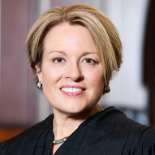

Donna Stroud
Republican | North Carolina





Candidate Profile*

Originalist

BIOGRAPHY
EDUCATION
Kinston High School, Kinston, NC, High school, 1982
Campbell University, Buies Creek, NC, BA, Government, summa cum laude, 1985
Campbell University School of Law, Raleigh, NC, JD, magna cum laude, 1988
WORK & MILITARY
Kirk,Gay, Kirk, Gwynn & Howell, Wendell, NC, Associate attorney, 1988-1991
Kirk, Gay, Kirk, Gwynn & Howell, Wendell NC, Partner, 1992-1995
Gay & Stroud, LLP, Zebulon, NC, Partner, 1995-2004
Wake County District Court (10th Judicial District), District Court Judge, 2004-2006
AFFILIATIONS
Zebulon Baptist Church, Member. Administrative deacon, Sunday School teacher, Choir and Handbell Choir, First Baptist Church, Kinston NC
Member, Youth group president, choir, handbell choir (middle school and high school), The Shepherd's Church, Cary NC (formerly known as Colonial Baptist), Member
Wendell Chamber of Commerce, Wendell NC, President, member, Arts Foundation, Wake County Republican Women
Member, NC Bar Association, Member since 1988; member of various committees over the years, currently a vice president
POLITICAL OFFICES HELD
District Court Judge, 10th Judicial District (Wake County), 2004-2006
Judge, NC Court of Appeals, 2006-present
POLITICAL OFFICES SOUGHT
(Candidate did not provide)
ENDORSEMENTS*
CONSERVATIVE (2)
*Durham County Republican Party
*Stand For Health Freedom
OTHER (1)
Mark D. Martin
REPORTED BY CANDIDATE (6)
Chief Justice Mark Martin, Supreme Court of North Carolina (former)
Justice George Wainwright, Jr. (former)
Justice Edward Thomas Brady (former)
Justice Barbara Jackson (former)
Justice Robert N. Hunter, Jr. (former)
SELECTED CONTRIBUTIONS
CONSERVATIVE
GIVEN BY CANDIDATE (1)
State Republican Party Organizations (2021)
RECEIVED BY CANDIDATE (22)
Chad Barefoot (2006)
Charlton Allen (2006)
Cherie Killian Berry (2006)
Dale Folwell (2006)
David R. Lewis Sr. (2006)
OTHER INFORMATION
Judge Stroud has served on the NC Court of Appeals since 2007. She has been the Chief Judge of the Court of Appeals since 2021.
Notable Cases:
- Cooper v. Berger (2019): Signed Judge Inman's majority opinion. Held that the General Assembly did not violate the NC Constitution by passing a budget apportioning federal block grant funds against the governor's preferred manner (2). Held that the court had jurisdiction because the interlocutory order was final as to the governor's challenge to the block grant appropriations (7). Analyzed the history and purpose of federal aid and block grants (9-17). Held that Garner v. Worth (1898) was not relevant precedent because it did not involve federal funds or a dispute over whether the State Treasurer had control of funds (25) Held that Gardner v. Board of Trustees of N.C. Local Governmental Employees’ Retirement System (1946) also did not necessarily exclude sources of income other than state-levied taxes, fines, etc from the ambit of "public funds," and it did not involve federal funds (23-24). Therefore, concluded that Gardner was not controlling (25). Held that the federal block grant statutes did not show an intent for executive control of the funds (26). Held that none of the statutes awarded the funds directly to the governor or a state agency (28). Held that block grants were not "custodial funds" under the NC Constitution (30).
- In Re K.R. (2021): Signed Jackson's majority opinion. Affirmed trial court's order that a child born positive for THC (marijuana) was neglected (1-2). Mother argued there was no evidence presented that baby Kim suffered harm as a result from THC being present in her body (2). The Court cited that the standard to affirm challenged sections of lower court's order was "clear and convincing evidence" (3). Cited similar cases of In re G.T, In re L.G.I, and In re M.J.G (4-6). Held that mother's DSS testimony was sufficient to support the trial court's finding regarding her marijuana use and its link to her housing and employment (11-12). Cited that exposure to a controlled substance qualified as actual impairment to a juvenile for the purpose of a neglect adjudication (12). Held that the evidence supported a finding of potential future neglect, although the trial court did not make such a finding (12-13).
- NAACP v. Moore (2020): Wrote concurrence. Stated that she reached the conclusion that the Superior Court was incorrect to nullify two state constitutional amendments proposed by the state legislature, after a federal court had declared in Covington that 28 of 170 of the General Assembly's legislators had been elected from gerrymandered districts on a more limited basis than the majority (21, 1-2). Stroud cited that the court is an error-correcting body, not a policy-making body (21). Argued that Covington did not support the argument that the General Assembly had no de jure or de facto legitimacy because Covington ordered that exact legislature to create new district to re-elect itself (22). As a result, argued there was no North Carolina law to support the trial court's legal conclusions (22). Held that the Covington court did not limit the allegedly illegitimate General Assembly's authority to make laws (31).
- Cooper v. Berger (2017): Signed per curiam majority opinion. Affirmed lower court's order upholding the constitutionality of two laws expanding senatorial advice and consent requirements to principal State department appointees created by statute and holding that such requirements did not violate separation of powers (1-4). Cited the 4th Circuit that there is no absolute bright line for separation of powers issues (9). Cited NC Supreme Court precedent of McCrory that separation of powers cases are determined case-by-case (10). Held that McCrory was distinguishable because it permitted the General Assembly to appoint constitutional officers, rather than the governor (12). Held that Session Law 2016-126 permitted the governor to appoint officers with the advice & consent of the senate (12). Cited McCrory's holding that the governor did not have exclusive authority to appoint “statutory officers to administrative commissions" (12). Cited that the NC Constitution was a limitation of power, and not a grant, and that the remaining power belonged to the people as represented through the General Assembly (13). Concluded that, while Article III, Section 5(8) granted the governor exclusive control to appoint constitutional officers, the governor failed to show that he had the exclusive power to appoint statutory officers (13). Concluded that the laws did not violate separation of powers (13-14).
- Richmond County Board of Education v. Cowell (2015): Signed Dillon's majority opinion. Held that N.C. Gen. Stat. § 7A304(a)(4b) (which put funds drawn from a $50 surcharge towards housing misdemeanor offenders in county jails) violated Article IX, Section 7(a) of the North Carolina Constitution, which mandated that the "clear proceeds" of all fines, penalties, and forfeitures be "used exclusively for maintaining" the public schools (1-3). Cited Mussallam that "penal laws" include “[punitive] laws that impose a monetary payment for their violation" (5). Held that the law at issue in this case was punitive (5). Therefore, held that the $50 surcharge fell within the ambit of Article IX, Section 7(a) (5). Held that it was proper for "all sums" to be ordered repaid (11).
Stroud's campaign website states that she is running to continue "enforcing the law as written, upholding the Constitutions of the United States and North Carolina, and ensuring every person in every case is treated fairly"
QUESTIONNAIRE
VALUES
I agree with Critical Race Theory (CRT) which asserts that the institutions in the United States are fundamentally racist.
Strongly Disagree
Judeo-Christian values established a framework of morality that is necessary for our system of limited government.
Strongly Agree
The preamble to the NC constitution confirms this: "We, the people of the State of North Carolina, grateful to Almighty God, the Sovereign Ruler of Nations, for the preservation of the American Union and the existence of our civil, political and religious liberties, and acknowledging our dependence upon Him for the continuance of those blessings to us and our posterity, do, for the more certain security thereof and for the better government of this State, ordain and establish this Constitution."
Briefly describe your spiritual beliefs and values.
I am a Christian and Jesus Christ is my personal savior. I believe the Bible is the inspired and inerrant Word of God. I strive to live my life and do my work in accord with my faith. My life verse is Ephesians 2:10: "For we are His workmanship, created in Christ Jesus for good works, which God prepared beforehand so that we would walk in them." I believe the works God prepared for me to do is my work as a judge on the Court of Appeals; it is my ministry. I have been married to my husband, Wilson, for 36 years, and we have two adult sons. We raised our children in the church and they were educated in private Christian schools from K-12.
What types of pro bono work have you done?
When I was practicing as an attorney, I represented some clients who could not afford to pay. This was not a formal pro bono program as I was in a small law firm, but it was part of our community service.
ABOUT YOU
What education or experience qualifies you to hold the office for which you seek election?
I listed my college and legal education in response to the "background information" section so I will not repeat those. I will add that I decided to be an attorney in 3rd grade and choose to attend Campbell University because it is a Christian college and because of the excellence of its law school. I took the prelaw curriculum with a major in government and finished in 3 years. In law school, I was ranked first in my class all 3 years and upon graduation. When I was in practice, I was also a certified Superior Court mediator and District Court arbitrator. I practiced in a small law firm ( 10 attorneys at the most, 2 at the least) in eastern Wake County and regularly practiced in 5 counties as well as handling cases in many other counties at times. I represented individuals, businesses, and towns in a wide variety of cases-civil, criminal, and administrative. My broad experience in litigation prepared me well for the Court of Appeals, since this Court hears all types of cases from trial courts and administrative agencies across the state. I have had real practical experience in nearly all of the types of cases which come before the court. In addition to my practical experience as an attorney, I served as a District Court judge so I also have practical courtroom experience as a trial judge. I have had extensive additional judicial education, beyond the CJE required for all judges, since I became a judge in 2004. I have an advanced degree in Judicial Studies from Duke Law School and have been teaching Judicial Process at Campbell University Law school since 2008. This class includes the study of the courts, judicial philosophy, and decision-making. I have 15 years of experience as an appellate judge and have authored over 1200 opinions and participated in over 3600 (since we hear cases in 3 judge panels). While on the Court of Appeals, I have also worked on several commissions and groups working to improve our courts including as Chair of the Chief Justice's Rules Advisory Commission and as a member of the Courts Commission; the Dispute Resolution Commission; the Chief Justice's Commission on Professionalism; the Family Court Advisory Commission; and the Task Force on Mental Health and Substance use established by Gov. McCrory. I also frequently teach judges in continuing judicial education classes for both District and Superior Court judges and lawyers in continuing legal education. I have also had the opportunity to learn from the other judges I have worked with on the Court of Appeals. I have worked with over 40 other judges during my 15 years on the court, so I have had the blessing of being able to learn from working with judges from a wide variety of backgrounds. All have taught me invaluable lessons about the work of our Court and how to improve the opinions I write for the court.
Why should the voters choose you?
Experience, integrity, and a proven track record. Anyone can say they are qualified to be an appellate judge or that they are a "true conservative." I ask to be judged by my actions, my record, and my reputation as a judge over the past 17 years. I have been true to my conservative principles for my entire adult life. I have written over 1200 opinions while on the Court of Appeals demonstrating my commitment to enforcing the law as written; my opponent has no record of detailed rulings. Voters should compare my qualifications and my record to those of my opponent. Although we have about the same number of years of experience since graduation from law school, her experience as a practicing attorney was very narrow. This is important because the Court of Appeals hears a huge variety of cases. Currently, about 34% of our cases are criminal; about 66% are civil. About half of the civil cases (32% of the total cases) are tort, contract, or real estate appeals; about 15% of the total caseload is abuse, neglect and dependency and termination of parental rights; about 13% is domestic; about 5% Industrial commission; and the remainder includes administrative and probate appeals. My opponent had no experience as an attorney in most of these types of cases and no experience as an appellate attorney. She has served as a District Court judge, as I did also, but as an attorney, she worked only as an assistant district attorney, in one judicial district, for 29 years. She represented one client, the State of North Carolina; in one type of case, criminal; in one judicial district. Criminal cases are a very important part of the Court of Appeal's work, but they are not even the majority of the cases before the court, and criminal cases have two sides: the prosecution and the defense. My opponent, as an assistant district attorney for her entire practice as an attorney, has never represented a family who has lost a loved one in an accident. She has never represented a small business owner in setting up a business or dealing with a dispute. She has never represented a person charged with a crime. She has never represented a client in a jury trial in a civil case; never prepared or probated a will; never searched a title or prepared a deed. I did all of these things and more for many years. As an attorney in private practice, I was also a small business owner; our firm employed other attorneys, paralegals, and other staff. I have had the experience of running a business and paying our employees; my opponent has not done this. As an appellate judge, I have also demonstrated my commitment to the Constitutions of North Carolina and the United States. As a recent example, I was in the majority in NAACP v. Moore, 273 NC App 452, 849 SE2d 87 (2020). This case involved the challenge to two of the constitutional amendments adopted by the voters in 2018. The trial court held the General Assembly lost its claim to popular sovereignty based upon gerrymandering so it had no power to pass the bill which submitted the amendments to the voters. The Court of Appeals reversed this ruling; it is now pending before the Supreme Court of North Carolina. I wrote a concurring opinion to emphasize the complete absence of any law to support the trial court's ruling and to stress that "neither this Court nor the trial court has the authority to declare new law which suits our policy preferences." In January 2012, Chief Justice Paul Newby appointed me as the first Republican Chief Judge of the Court of Appeals since it began in 1967. The Chief Judge has the same role in deciding cases as the other 14 judges on the court but has additional administrative duties. One of my priorities as Chief Judge has been to provide the open courts guaranteed by the North Carolina constitution. Our court began holding arguments by WebEx in March 2020 due to the pandemic; after I became Chief Judge, we resumed holding oral arguments in person in April of 2021. At the Court of Appeals building, after I became Chief Judge, our employees and staff made their own personal decisions regarding whether to wear masks or be vaccinated. Although our arguments are now in person, we continue to livestream our court proceedings on Youtube and recently created a podcast of the proceedings also. All of our opinions are also available at nccourts.org. I have worked to improve the Court of Appeals as well as the trial courts for years. For example, I serve as Chair of the Chief Justice's Rules Advisory Commission, which has been working since 2018 on changes to rules needed to implement electronic filing in all of North Carolina's trial courts.
I voted in these primaries and general elections:
Did not answer
I don't believe there was a Republican primary I was able to vote in in 2018. The primaries were cancelled for statewide judicial offices that year. I don't believe I have missed voting an election in many years, and I have been registered as a Republican since I was 18.
JUDICIAL PHILOSOPHY
Justices should not interpret the federal and state constitutions as living documents, but should use a textualist and originalist approach to interpretation.
Strongly Agree
What is the proper use of legislative history in interpreting statutory law?
Under North Carolina law, the use of legislative history is very limited and uncommon. North Carolina has essentially no legislative history for laws passed by the General Assembly beyond the language of the statutes themselves. Normally, the only role legislative history has is simply as a comparison to a prior version of a statute with an amended statute. Even then, we cannot consider legislative history at all unless the language of the statute is unclear or ambiguous. If the statute's language is clear, we simply apply the plain meaning of the statute.
Which current or past U.S. Supreme Court justice best reflects your judicial philosophy?
My judicial philosophy is most aligned with Justice Samuel Alito. He was one of our instructors in judicial writing at the Duke LLM program so I had the privilege and honor of being able to meet him and learn about his approach to cases directly from him.
How should a court address the balance between public health and individual freedoms in the time of a pandemic?
Under the Code of Judicial Conduct, I cannot state how I would rule in any case that may come before the court. However, I can state my own opinion, and I believe the Constitution is not suspended during a pandemic, although many authorities seem to believe it was. In considering any issues, a court must rule based upon the law and the evidence before the court. Individual freedoms should not be limited unless the need for any limitation is clearly established by real medical evidence shown by valid and reliable research -- not guesses or estimates -- and even then, any restrictions should be as limited in scope and time as necessary. In addition, a court should balance the consequences and costs of any limitations against the actual benefits from the limitations. Every limitation of individual freedoms has a cost, and many of an pandemic restrictions seem to have ignored any potential costs or harmful consequences.
In light of the case Bostock v. Clayton County, in which the U.S. Supreme Court interpreted the 1964 Civil Rights Act to include a prohibition on sexual-orientation discrimination, which justice’s opinion most closely aligns with your own opinion?
Justice Alito's dissent.
What role (if any) does a judge have in maintaining the separation of church and state?
Separation of church and state is not a concept explicitly in the Constitution; this concept is based upon an interpretation of the establishment clause of the 1st Amendment. A judge's role, particularly on the North Carolina Court of Appeals, is to address any constitutional issue regarding freedom of religion in accord with the Constitution and the law as set out by the Supreme Court.
Religious liberty is at risk in the United States and deserves the highest level of protection in the law.
Strongly Agree
When should a judge overturn past court decisions?
The Court of Appeals does not have the authority to overturn past court decisions, even if we believe a prior decision to be in error. The Supreme Court of North Carolina has the authority to overturn a past decision of the Court of Appeals or its own prior decision.
How should a judge determine which rights are protected by the Constitution even though they are not specifically mentioned?
On the Court of Appeals, we must follow the law as set out by the US Supreme Court or the Supreme Court of North Carolina. These rights should be clearly set out in the Constitution and not created by a court.
What legal principles should a court consider when evaluating parents’ objection to their child obtaining medical procedures or drugs designed to affirm the child’s desired gender?
It is well established that parents have a constitutionally protected right to the care, custody, and control of their children. The United States Supreme Court has long recognized the protection of the integrity of the family unit and of the control and nurture of children under several constitutional provisions, including the due process clause of the 14th Amendment and the Equal Protection clause. This right to care, custody, and control of a child can be infringed only if the parent is unfit or acts in a way inconsistent with his or her rights as a parents, such as by abandoning a child or abusing a child.
What principles should guide a court’s analysis of whether your state’s constitution gives terminally ill patients a right to assisted suicide?
North Carolina's constitution does not give a right to assisted suicide. Assisted suicide is illegal in North Carolina and any change in the law must come from the General Assembly.
Would you describe your judicial philosophy as originalist, living constitutionalist, or something else?
Originalist and textualist