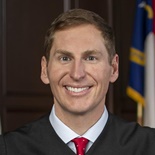
Jefferson G. Griffin
Republican | North Carolina





Candidate Profile*

Originalist

BIOGRAPHY
EDUCATION
Judge Advocate Legal Center and School, Charlottesville, VA, Judge Advocate Officer Basic Course, 2017
North Carolina Central University School of Law, Durham, NC, J.D., 2008
University of North Carolina, Chapel Hill, NC, B.A. in History and Political Science, 2003
Judge Advocate Legal Center and School, Charlottesville, VA, Judge Advocate Officer Advanced Course, 2020
WORK & MILITARY
North Carolina Army National Guard, Captain, 2018 - present
North Carolina Army National Guard, First Lieutenant, 2017 - 2018
US Army (mobilized), Captain, 2019-2020
AFFILIATIONS
Holy Trinity Anglican Church, Member, Kiwanis Club of Raleigh
Board of Directors, Membership Chair, Member, Wake County Bar Association, Board of Directors, Member
Lenoir County Bar Association, President, Member, Step Up Ministry
Co-partner and adult life skills mentor, Enloe High School, Volunteer Football Coach
POLITICAL OFFICES HELD
Wake County District Court Judge (appointed 2015, elected 2016), 2015 - 2020
NC Court of Appeals Judge (elected statewide 2020), 2021-present
POLITICAL OFFICES SOUGHT
Wake County District Attorney, 2014
ENDORSEMENTS*
CONSERVATIVE (7)
*National Right To Life
North Carolina Values Coalition
Wake GOP
*Carolina Teachers Alliance
Judge Voter Guide
OTHER (1)
*NC Asian American Coalition
SELECTED CONTRIBUTIONS
CONSERVATIVE
GIVEN BY CANDIDATE (6)
Local, County, and District Republican Organizations (2023)
Republican Women's Organizations (2022)
State Republican Party Organizations (2022)
Dan Forest (2015)
Pat McCrory (2015)
RECEIVED BY CANDIDATE (59)
Charles F. Fuller (2024)
Dennis Riddell (2024)
Erin Pare (2024)
Jake Johnson (2024)
Jamie Boles (2024)
LIBERAL
GIVEN BY CANDIDATE (0)
RECEIVED BY CANDIDATE (1)
North Carolina Advocates for Justice (2020)
OTHER INFORMATION
Judge Voter Guide "endorsed" Griffin and gave him 5 stars rating.
Justice Griffin's campaign website states that, "Judge Griffin is an originalist and a textualist. Judge Griffin believes the words of the Constitution mean what they say. Judge Griffin believes in the separation of powers, judicial restraint and the independence of the judiciary.”
Judge Griffin's campaign page states: "Protecting Our Constitution. Integrity in the Courtroom. Defending the Rule of Law."
Justice Griffin's campaign website states, "Protecting Our Constitution. Integrity in the Courtroom. Defending Rule of Law."
Matter of Z.M.C.B., No. COA23-1024, 2024 WL 3039813 (N.C. Ct. App. June 18, 2024) Griffin authored the opinion. *involves key issue*
Holding: The Court of Appeals held that “the trial court did not err in terminating Mother’s parental rights under section 7B-1111(a)(3).” (8) The Court concluded that “YFS presented undisputed clear, cogent, and convincing evidence to support Finding of Fact 24, and Findings of Fact 24 and 25 [were] sufficient to support the trial court’s conclusion that grounds existed to terminate Mother’s parental rights under section 7B-1111(a)(3).” (8) The Court found that the North Carolina “Supreme Court ha[d] held that additional evidence of a parent’s living expenses [was] irrelevant undersection 7B-1111(a)(3) where the evidence presented shows the parent ‘made no payments whatsoever to cover the costs of [his child’s] care, [and] the trial court found that [the parent] was employed with some income[.]’” (7) The Court stated that the trial court found that Mother “had gainful employment throughout the relevant period[]” and that the Court “will not reweigh the evidence, notwithstanding the existence of contradictory evidence presented during the hearing.” (8)
Background: “Mother appeals the trial court’s Termination Order, arguing the court erred in terminating her parental rights under each of N.C. Gen. Stat. §§ 7B-1111(a)(1), (a)(2), (a)(3), and (a)(6) at the adjudication stage.” (4) Mother challenged Finding of Fact 24 arguing that “[t]he trial court’s findings that [Mother] had the ability to pay a sum greater than zero and willfully failed to do so [were] not supported by clear and convincing evidence.” (6-7) Mother argued that conflicting evidence was presented during the hearing and asserted that YFS failed to provide proof of her ability to pay. The Court "review[s] a trial court’s adjudication under [N.C. Gen. Stat.] § 7B-1111 to determine whether the findings are supported by clear, cogent, and convincing evidence and the findings support the conclusions of law.” (4-5) “The court’s ‘conclusions of law are reviewed de novo.’’ (5)
Rule(s): Applicable law: “Section 7B-1111 of the North Carolina General Statutes states ‘[t]he court may terminate [a parent’s] parental rights upon a finding of one or more of’ eleven enumerated grounds. N.C. Gen. Stat. § 7B-1111(a) (2023).” (5) “[A]n adjudication of any single ground in [N.C. Gen. Stat.] § 7B-1111(a) is sufficient to support a termination of parental rights.” (6)
Matter of N.J.R.C., 291 N.C. App. 174, 895 S.E.2d 443 (2023) Griffin authored the opinion. *Involved key issue*
Holding(s): The Court held that “[b]ecause Father was convicted of taking indecent liberties with children under N.C. Gen. Stat. § 14-202.1—a sexually related offense—and because the relations which resulted in the conception of Nathan also led to Father’s conviction under Chapter 14, the trial court did not err in finding grounds for termination of Father’s parental rights under N.C. Gen. Stat. § 7B-1111(a)(11).” (7) The Court found that, “the ‘Related’ language provided in the statute, together with our Courts’ precedent, indicate[d] the offense of taking indecent liberties with children under N.C. Gen. Stat. § 14-202.1 constitutes a sexually related offense within the meaning of N.C. Gen. Stat. § 7B-1111(a)(11).” (7) Additionally, “Section 7B-1111(a)(11) does not require a respondent to be convicted of a sexual act or offense, but only of a ‘sexually related offense.’” (5)
Background: “Father argue[d] there was insufficient evidence to support a termination under section 7B-1111(a)(11) because he was not convicted of a sexually related offense.” (1) "When a respondent appeals a courts adjudication decision this Court reviews the “decision to determine ‘whether the findings of fact are supported by clear, cogent and convincing evidence and whether [the] findings, in turn, support the conclusions of law.’” (3)
Rule(s): “Under our North Carolina General Statutes, section 7B-1111(a)(11), the trial court may terminate a parent’s rights upon finding ‘[t]he parent has been convicted of a sexually related offense under Chapter 14 of the General Statutes that resulted in the conception of the juvenile.’ N.C. Gen. Stat. § 7B-1111(a)(11) (2021).” (4) Chapter14, section 202.1 states, “(a) A person is guilty of taking indecent liberties with children if, being 16 years of age or more and at least five years older than the child in question, he either: (1) Willfully takes or attempts to take any immoral, improper, or indecent liberties with any child of either sex under the age of 16 years for the purpose of arousing or gratifying sexual desire; or (2) Willfully commits or attempts to commit any lewd or lascivious act upon or with the body or any part or member of the body of any child of either sex under the age of 16 years.” (4)
Vaitovas v. City of Greenville, 2022-NCCOA-169, 282 N.C. App. 393, 871 S.E.2d 816, appeal dismissed, review denied, 873 S.E.2d 10 (N.C. 2022). Dietz wrote majority opinion.
Holding(s): The Court held that a law governing automated traffic signal cameras (present only in some cities in NC) did not violate N.C. Const. art. II § 24(1)(a), which prohibits "local" laws "[r]elating to health, sanitation, and abatement of nuisances" because the precedent of City of Asheville v. State (2016) limited the phrase "relating to" to laws with a "material" connection to health and not those with a "tangential or incidental connection" (1-2). The Court noted that the plaintiff did not challenge the statute that authorized Greenville to use the cameras, but rather a law governing the city's ability to lease the cameras (2). The Court held that the challenged act did not shift responsibility for the program and did not change the health-related aspects of the program. The Court held that whether the underlying statute authorizing the cameras was unconstitutional was not before the court (3). Said that Vaitovas' reference to public statements by city officials did not prove that the purpose of the statute was health related because "what individual legislators think about the purpose of a statute is rarely (if ever) helpful in interpreting the intent of the General Assembly as a whole. And what local officials think about a statute is even less so" (9). The Court held that the challenged law did not materially affect health because it neither changed who was responsible for the cameras nor how the cameras operated (10).
Background: North Carolina's General Assembly passed a law allowing the City of Charlotte to establish an automated red-light camera program for traffic enforcement. Over time, this law was extended to several other cities and towns in the state. Later, the City of Greenville was added to the statute. In 2016, Greenville sought legislative changes to make the red-light camera program financially feasible, specifically requesting the ability to contract with private entities for camera equipment. The General Assembly passed Session Law 2016-64, which allowed Greenville to lease or purchase the equipment and set specific terms for such contracts. In 2018, Vaitovas contested a red-light violation notice she received, arguing that the 2016 law was unconstitutional under North Carolina’s limitation on local health laws. "Vaitovas argue[d] that Session Law 2016-64 [wa]s unconstitutional because it [wa]s barred by Article II, Section 24(1)(a) of the North Carolina Constitution, which prevents the General Assembly from passing any local acts related to health: (1) Prohibited Subjects. The General Assembly shall not enact any local, private, or special act or resolution: (a) Relating to health, sanitation, and the abatement of nuisances . . . (3) Prohibited acts void. Any local, private, or special act or resolution enacted in violation of the provisions of this Section shall be void. N.C. Const. art II, § 24(1)(a), (3)." (8)
State v. Johnson, 2021-NCSC-85, 378 N.C. 236, 861 S.E.2d 474 Griffin concurred with separate opinion.
Holding(s): The Court of Appeals (Court) "reverse[d] the trial court’s denial of Defendant's Motion to Suppress, vacate[d] the Judgment, and remand[ed] this matter for further proceedings.” (23) The Court “exercis[ed] [its] Rule 2 discretion to address the merits of Defendant’s arguments.” (12) The Court held that the search conducted by Lieutenant Stone “measurably —and impermissibly—extended the traffic stop[.]” (22) The Court found that the Defendant’s consent was involuntary as a matter of law. The Court found that Lieutenant Stone did not receive consent nor have reasonable suspicion of criminal activity to conduct a full search of defendant’s pockets.
Griffin's Concurrence: Griffin concurred with the reasoning of the majority and wrote separately “to indicate exactly where Lieutenant Stone violated the Fourth Amendment to the U.S.” (26) Griffin noted that while the initial traffic stop was justified based on the observed seatbelt violation, and Lieutenant Stone was legally permitted to ask the Defendant to exit the vehicle for safety reasons, the issue arises when Stone requested to search the Defendant's person. This request lacked additional reasonable suspicion of other criminal activity and unreasonably extended the duration of the stop, which violated the Fourth Amendment. Griffin also addressed Defendant argument “that U.S. citizens are treated differently under our laws based on the color of their skin.” (28) He wrote “I reject this argument. The law is color blind and applies equally to every citizen in the United States of American. This argument is Defendant’s brief is inflammatory and unnecessary.” (28-29) He further stated that “[t]he brief quoted former North Carolina Chief Justice Beasley, who also implied in a speech on 2 June 2020 that our justice system does not treat people equally in the courtroom based on the color of their skin[.]” (29) Judge Griffin found that “Defendant’s statement highlights the problem with the judiciary becoming involved in public policy.” (30) “It also encourages and charges the courts to become an active body by involving our judicial branch in policy decisions. The judiciary should at all times practice judicial restraint.” (31)
Background: Johnson appealed a judgment entered following his guilty pleas to Felony Possession of Cocaine and Habitual-Felon Status. The case stemmed from a traffic stop in 2017, by Lieutenant Stone. Stone stopped Johnson for not wearing a seatbelt and, after informing Johnson that he would issue only a warning, asked to search him. Johnson consented, and Stone discovered what he believed to be cocaine in Johnson's pocket. Johnson filed a Motion to Suppress the evidence, arguing that the traffic stop was unlawful and that his consent to search did not extend beyond a pat-down for weapons. At the suppression hearing, both Stone and Johnson provided conflicting accounts of the consent given. The trial court denied the motion, finding that the officer had reasonable suspicion for the stop and that Johnson had consented to the search. After his Motion to Suppress was denied, Johnson plead guilty to Felony Possession of Cocaine and Habitual-Felon Status. In his Transcript of Plea, Johnson reserved the right to appeal the denial of his Motion to Suppress. He provided oral Notice of Appeal at the plea hearing and filed a written Notice of Appeal.
On appeal, the issues were whether: (I) Defendant preserved his argument that his consent to the search was involuntary because Lieutenant Stone extended and deviated from the original traffic stop; and (II) the trial court erred in denying Defendant’s Motion to Suppress evidence of the cocaine, based on the claim that his consent was involuntary as a matter of law.
Conclusion(s): The Court held that the funding framework of Greenville’s Red Light Camera Enforcement Program violated the Fines and Forfeitures Clause of the North Carolina Constitution. Thus, the Court reversed the trial court's dismissal of the plaintiffs' claim related to this clause and remanded the case for summary judgment in the plaintiffs' favor. The Court otherwise affirmed the trial court's other decisions. Additionally, the Court held that the plaintiffs’ argument, regarding the trial court's consideration of an unqualified expert's affidavit, was not preserved for appeal.
Holding(s) & Analysis: The Court first held that the trial court correctly dismissed the plaintiffs' claim under Chapter 89C of the North Carolina General Statutes finding that Chapter 89C does not provide a private right of action for violations of its provisions. Second the Court next that Greenville’s RLCEP’s administrative appeal hearings do not violate procedural due process. Procedural due process requires notice and an opportunity to be heard at a meaningful time and in a meaningful manner. The Court concluded that Greenville’s process, which included an administrative hearing and the option to appeal to Superior Court by certiorari, meets these requirements. Next the Court found that Greenville’s RLCEP does not infringe upon fundamental rights and was rationally related to a legitimate government purpose—public safety. The Court noted, the law’s aim was to address safety hazards caused by red light violations, and although the effectiveness of the RLCEP in specific scenarios can be debated, it is reasonably related to the goal of improving public safety. The Court emphasized that it does not assess policy effectiveness but rather ensures that the law has a rational connection to its stated goals. Lastly, the Court held that the RLCEP's funding scheme violated the Fines and Forfeitures Clause of Article IX, Section 7 of the North Carolina State Constitution. The Clause mandates that "clear proceeds" of fines and forfeitures be used exclusively for maintaining free public schools. (27) The Court found that Greenville's interlocal agreement with the School Board did not comply with this requirement. Therefore, the Court reversed the trial court's order and remanded the case for summary judgment in favor of the Plaintiffs.
Background: Under North Carolina law, failure to stop at a red light is an infraction with a maximum penalty of $100. However, municipalities are allowed to use red light cameras for civil enforcement. In 2016, the General Assembly authorized Greenville to implement a Red Light Camera Enforcement Program (RLCEP), which imposed a $100 civil penalty for red light violations. Greenville entered into a contract with American Traffic Solutions (ATS) for managing the RLCEP. The agreement involved Greenville collecting the fines and forwarding them to the School Board, which then reimbursed Greenville for its expenses. From 2017 to mid-2019, the School Board received a substantial portion of the fines collected. Plaintiffs, Fearrington and Malmrose, appealed the denial of their motion for summary judgment and the granting of motions to dismiss by the City of Greenville and the Pitt County Board of Education. They contended that Greenville's Red Light Camera Enforcement Program (RLCEP) was illegal and unconstitutional. The court found that the RLCEP's funding framework violated the Fines and Forfeitures Clause of the North Carolina Constitution.
Posted Facebook, "These conservative statewide judicial candidates are committed to upholding the law, defending the Constitution, and ensuring a balanced and fair judiciary."
From Judge Griffin's campaign page states: "JUDGE GRIFFIN’S JUDICIAL PHILOSOPHY: Judge Griffin is an originalist and a textualist. Judge Griffin believes the words of the Constitution mean what they say. Judge Griffin believes in the separation of powers, judicial restraint and the independence of the judiciary."
State v. Cable, No. COA23-192, 2024 WL 3033884 (N.C. Ct. App. June 18, 2024). Authored opinion.
Holding(s): The Court held that Defendant Kimberly Cable's convictions for two counts of failure to store a firearm to protect a minor and involuntary manslaughter were in error. The Court reversed the convictions for failure to store a firearm and vacated the conviction for involuntary manslaughter.
Background: The case stemmed from an incident where a 16-year-old boy, Kevin, accidentally shot himself with a revolver while visiting Defendant's home. The Court found that there was insufficient evidence to support the failure to store a firearm charges because the revolver in question was unloaded and thus not stored "in a condition that the firearm can be discharged," as required by N.C. Gen. Stat. § 14-315.1. Additionally, the Court found that there was no substantial evidence that Kevin accessed any firearms other than the revolver or that he caused the death with another firearm. Consequently, the Court reversed Defendant's convictions for failure to store a firearm to protect a minor and vacated her conviction for involuntary manslaughter, which was based on the reversed misdemeanor conviction.
Applicable Law: "North Carolina General Statutes, section 14-315.1 states, in part: (a) Any person who resides in the same premises as a minor, owns or possesses a firearm, and stores or leaves the firearm (i) in a condition that the firearm can be discharged and (ii) in a manner that the person knew or should have known that an unsupervised minor would be able to gain access to the firearm, is guilty of a Class 1 misdemeanor if a minor gains access to the firearm without the lawful permission of the minor’s parents or a person having charge of the minor and the minor: . . .(3) Causes personal injury or death with it not in self defense; or . . . (b) Nothing in this section shall prohibit a person from carrying a firearm on his or her body, or placed in such close proximity that it can be used as easily and quickly as if carried on the body. N.C. Gen. Stat. § 14-315.1(a)-(b) (2023)." (7)
See also: "Unloaded Weapons Don't Violate North Carolina Safe Gun Storage Law, Appeals Court Says." Associated Press, 18 June 2024.
QUESTIONNAIRE
RIGHT TO LIFE
Was Dobbs v. Jackson rightly decided according to the text of the Constitution? Please explain.
Judicial standards prevent me from commenting on issues that could come before me as a jurist.
I support a right to accelerate ending a human life.
Choose not to answer
Judicial standards prevent me from commenting on issues that could come before me as a jurist.
Human life deserves legal protection from conception until natural death.
Choose not to answer
Judicial standards prevent me from commenting on issues that could come before me as a jurist.
RELIGIOUS LIBERTY
Religious liberty is at risk in the United States.
Choose not to answer
Judicial standards prevent me from commenting on issues that could come before me as a jurist.
VALUES
Briefly describe your spiritual beliefs and values.
I am a Christian. I believe my most important job is that of being a father to my two young children. I believe in servant leadership.
What is your view of parental rights regarding the upbringing of children, specifically education and sexual "identity"?
Judicial standards prevent me from commenting on issues that could come before me as a jurist.
I support "gender identity" as a specially protected class. Please explain.
Choose not to answer
Judicial standards prevent me from commenting on issues that could come before me as a jurist.
What do you believe to be true about the human condition?
Judicial standards prevent me from commenting on issues that could come before me as a jurist.
EQUALITY
I agree with Critical Race Theory (CRT).
Choose not to answer
Judicial standards prevent me from commenting on issues that could come before me as a jurist.
ABOUT YOU
What, if any, church or organizations do you belong to?
Holy Trinity Anglican Church, US Army, North Carolina National Guard, Raleigh Kiwanis Club, Veterans of Foreign Wars, American Legion, North Carolina National Guard Association
I voted in these primaries and general elections:
2014 Republican Primary 2014 General Election 2016 Republican Primary 2016 General Election 2018 General Election 2020 Republican Primary 2020 General Election 2022 Republican Primary 2022 General Election
There was no primary election I could vote in in 2018.
Have you ever been convicted of a felony? If so, please explain.
No
Have you ever been penalized for sexual misconduct in either civil or criminal court? If so, please explain.
No
Would you describe your judicial philosophy as originalist, living constitutionalist, or something else? Please explain.
Originalist. I believe we should use original meaning of the words to interpret the law. This is the most consistent way to interpret the law and protects against judicial activism.
JUDICIAL PHILOSOPHY
Which current or past U.S. Supreme Court justice best reflects your judicial philosophy?
Scalia and Gorsuch
Is there a separation of church and state in the Constitution? Please explain.
Judicial standards prevent me from commenting on issues that could come before me as a jurist.
Should courts address threats to religious liberty in the United States? If so, how?
Judicial standards prevent me from commenting on issues that could come before me as a jurist.
Was Obergefell v. Hodges rightly decided according to the text of the Constitution? Please explain.
Judicial standards prevent me from commenting on issues that could come before me as a jurist.
Was Bostock v. Clayton County rightly decided under the law? Please explain.
Judicial standards prevent me from commenting on issues that could come before me as a jurist.
I agree that “the custody, care and nurture of the child reside first in the parents, whose primary function and freedom include preparation for obligations the state can neither supply nor hinder.” (Troxel v. Granville, 530 U.S. 57, 65-66 (2000); quoting Prince v. Massachusetts, 321 U.S. 158, 166 (1944).
Choose not to answer
Judicial standards prevent me from commenting on issues that could come before me as a jurist.
What should a judge do when legislative texts and court precedents dictate different results?
I consistently use an originalist approach to interpret the law.
When should a judge overturn past court decisions?
When the interpretation of the law was clearly erroneous and had no basis in the law.
When, if ever, should a judge take popular opinion or the social views of the majority into consideration?
Never.
Do you believe the meaning of the Constitution changes over time, absent changes through the amendment process of Article V?
No
What do you believe is the single most important quality a judge should possess?
Humility
If you are an incumbent judge, describe a recent instance in which you acted to preserve your judicial independence. If you are an aspiring judge, how do you plan to remain independent if elected to the bench?
I am consistent in my interpretation of the law, even if I do not agree with the result. It is not my job as a jurist to make policy. I have consistently sought greater transparency at our Court even when faced with resistance.
2ND AMENDMENT
The right to bear arms is fundamental and must be protected.
Choose not to answer
I do believe in the original meaning of the Second Amendment.
OTHER IMPORTANT ISSUES
Which branch of government do you believe was intended to wield the most authority?
Judicial standards prevent me from commenting on issues that could come before me as a jurist.
How should the court address public health and individual freedoms in the time of a public health emergency?
see above