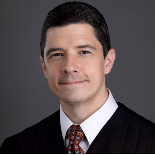
Brett Busby
Republican | Texas


Candidate Profile*

Originalist

BIOGRAPHY
EDUCATION
Duke University, Durham, NC, B.A., 1991-1995
Columbia Law School, New York, NY, J.D., 1995-1998
WORK & MILITARY
Bracewell LLP, Partner, 2008-2012
Mayer Brown LLP, Associate and Partner, 2003-2008
Hogan Dubose & Townsend LLP, Associate, 2000-2003
Supreme Court of the United States, Law Clerk, 1999-2000
U.S. Court of Appeals, Eleventh Circuit, Law Clerk, 1998-1999
AFFILIATIONS
United Methodist Church, Member, 1988-
Boy Scouts of America, Eagle Scout and Parent Merit Badge Coach, 1985-
Houston Symphony Board, Vice President, Artistic Affairs, 2010-2020
Houston Civic Symphony, Member, First Violin Section, 2002-2020
POLITICAL OFFICES HELD
Justice, Supreme Court of Texas, 2019-
Justice, Texas Court of Appeals, 14th District, 2012-2018
POLITICAL OFFICES SOUGHT
Candidate did not provide
ENDORSEMENTS*
CONSERVATIVE (6)
Texas Home School Coalition THSC PAC
Texas Values Action
Life PAC
*Texas Young Republicans
True Texas Project
LIBERAL (1)
Houston Police Officers Union PAC
OTHER (5)
Texas Oil and Gas Association TXOGA PAC
C Club of Houston
Texas Alliance for Life TAL PAC
Texas Association of Realtors TREPAC
Houston Region Business Coalition HRBC
SELECTED CONTRIBUTIONS
CONSERVATIVE
GIVEN BY CANDIDATE (37)
Jessica Hart Steinmann (2026)
Local, County, and District Republican Organizations (2026)
Local, County, District Republican Organizations (2026)
Brett Busby (2020)
Republican Womens Organizations (2019)
RECEIVED BY CANDIDATE (41)
Harlan & Katherine Crow (2026)
Henry Ross Perot (2026)
Local, County, and District Republican Organizations (2026)
Republican Womens Organizations (2026)
Stuart Stedman (2026)
LIBERAL
GIVEN BY CANDIDATE (1)
Local, County, District Democratic Organizations (2011)
RECEIVED BY CANDIDATE (1)
Adam Loewy (2025)
OTHER INFORMATION
Candidate interivew. Texas Young Lawyers Association Young Gunners Podcast. 20 May 2025. 43:32 min.
Justice Busby emphasized rule of law and judicial restraint, stating that a judge’s role is to “interpret the Constitution and laws as they were written, not to legislate from the bench,” and to decide cases “as the law requires,” rather than based on personal preferences.
In regard to the proper role of the court, Justice Busby stated it's to “decide cases,” and not to “elaborate and expand laws in order to make them easier to understand or enforce[.]"
Justice Busby stated that “A strong judiciary provides clear and consistent guidance that helps Texans understand their rights and responsibilities under the law.” He emphasized that “Courts have a duty to apply the Constitution faithfully so that decisions are grounded in principle rather than preference,” adding that “neutrality and careful reasoning” guide his work on the Court.
In State v. Zurawski (2024), Justice Busby concurred separately in the Texas Supreme Court’s decision vacating an injunction that had expanded Texas’s abortion-law exceptions. The Court held that Texas law already permits abortions when, using reasonable medical judgment, a physician determines that a pregnant woman faces a life-threatening condition or serious risk of physical impairment. Busby agreed but focused on the need for clear laws and limits on judicial policymaking. He emphasized that the Legislature has authority to regulate abortion, while courts must interpret—not rewrite—the law. He also stressed that abortion laws can affect the life and liberty of both women and unborn children and therefore must clearly explain when an abortion is legally permitted.
In State v. Loe (2024), Justice Busby concurred separately in the Texas Supreme Court’s decision upholding Senate Bill 14, which restricts certain gender-transition treatments for minors. The Court held that the law did not violate parents’ constitutional rights because the specific treatments were new and not deeply rooted in American history and tradition. Busby agreed with that result but stressed that parents still have broad, constitutionally protected authority over traditional decisions about raising and caring for their children. He warned that courts should not define parental rights based simply on what the government has authority to regulate. Instead, courts must first determine whether the particular parental decision is historically protected.
In In re Dallas HERO (2024), Justice Busby wrote the Court’s opinion, holding that three Dallas City Council ballot propositions could not appear on the ballot because their wording would confuse voters. The issue was whether the Council could put competing propositions on the ballot that could override citizen-initiated amendments. Busby emphasized that voters must be given ballot language that clearly explains a proposition’s purpose and important features. Because the Council’s propositions conflicted with the citizen initiatives without explaining those conflicts, the Court ordered them removed from the ballot. Busby’s opinion strongly emphasized protecting voters from misleading ballot language and preserving the people’s power to use ballot initiatives.
In Ferguson v. Tex. Dep’t of Pub. Safety (2021), Justice Busby concurred in the Texas Supreme Court’s decision not to hear Ferguson’s challenge to the suspension of his handgun license. Busby agreed that the Court should not decide whether the Second Amendment protects carrying a handgun in public because Ferguson had not raised that argument in the trial court. He also noted that a new Texas law would soon allow most adults to carry handguns without a license, making the issue less important. Busby emphasized that courts should decide the actual case before them rather than reach constitutional questions that are unnecessary to the outcome.
In In re Steven Hotze (2020), Justice Busby joined Justice Blacklock’s concurrence in the Texas Supreme Court’s decision denying a challenge to the Governor’s COVID-19 changes to election rules. The Court refused to intervene because the challengers waited too long and did not properly establish standing. Blacklock, joined by Busby, focused on judicial power and separation of powers, arguing that courts cannot decide constitutional questions unless they have jurisdiction over the case. He stressed that even during an emergency, courts must stay within their constitutional limits rather than use the crisis as a reason to expand their authority.
In In re State of Texas (2020), Justice Busby joined Justice Guzman’s concurrence in the Texas Supreme Court’s COVID-19 mail-in voting case. The issue was whether any voter who lacked immunity to COVID-19 could automatically qualify to vote by mail because of a “disability.” The Court held that lack of immunity alone did not qualify under the Election Code. Guzman’s concurrence, joined by Busby, emphasized that the statute’s wording still allowed voters to consider their individual health and circumstances when deciding whether voting in person was likely to harm them. The concurrence also stressed that the Court’s job was to carefully interpret the Legislature’s enacted rules rather than change them.
QUESTIONNAIRE
RIGHT TO LIFE
Was Dobbs v. Jackson rightly decided according to the text of the Constitution? Please explain. (Holding: In Dobbs, the U.S. Supreme Court held that the federal constitution does not confer a right to abortion.)
Did not answer
Does the federal Constitution support the right to physician assisted suicide? Please explain in light of Washington v. Glucksberg (1997).
Did not answer
Human life deserves legal protection from conception until natural death.
Choose not to answer
How do you view the judiciary’s role in matters of abortion regulation following Dobbs?
Did not answer
RELIGIOUS LIBERTY
Do you believe religious liberty is at risk in the United States. If so, what is the judiciary's proper role in addressing this issue?
Did not answer
Does the Establishment Clause of the First Amendment require government to be strictly secular or does it allow for the nation's religious heritage?
Did not answer
Was Masterpiece Cakeshop, Ltd. v. Colorado Civil Rights Commission rightly decided according to the text of the Constitution? Please explain. (Holding: The U.S. Supreme Court held tha the state may not show religious hostility when enforcing anti-discrimination laws against a business owner.)
Did not answer
VALUES
Briefly describe your spiritual beliefs and values.
Did not answer
What is your understanding of parental rights under the Constitution regarding the upbringing of children, particularly regarding choices about education and sexual identity?
Did not answer
Is gender identity a protected class under the Constitution? Please explain the constitutional basis for your view.
Did not answer
ABOUT YOU
Have you ever been convicted of a felony? If so, please explain.
No
Have you ever been penalized for sexual misconduct in either civil or criminal court? If so, please explain.
No
I voted in these primaries and general elections:
Did not answer
JUDICIAL PHILOSOPHY
Describe your judicial philosophy.
Did not answer
Do you believe judges should primarily apply the law according to its original public meaning, or do you believe the law evolves over time to reflect contemporary values?
Did not answer
Which current or past U.S. Supreme Court justice best reflects your judicial philosophy?
Did not answer
Was Obergefell v. Hodges rightly decided according to the text of the Constitution? Please explain. (Holding: The U.S. Supreme Court held Due Process and Equal Protection Clauses create a right for same-sex couples to marry.)
Did not answer
A. How should a judge approach a case where the constitutional or statutory text is clear on its face? B. Conversely, how should a judge proceed when the text is ambiguous or silent on a disputed issue?
Did not answer
What is your view of judicial restraint versus judicial activism? How do you define each?
Did not answer
What is the proper role of a judge?
Did not answer
When applying or interpreting the text of a statute or constitutional provision, is it ever proper for a judge to consider present day public opinion or consequences?
Did not answer
If precedent departs from the Constitution’s text or original meaning, should a judge follow it or correct the error? Please explain.
Did not answer
2ND AMENDMENT
What is your understanding of the Second Amendment’s right to keep and bear arms?
Did not answer
OTHER IMPORTANT ISSUES
Which branch of government do you believe was intended to wield the most authority?
Did not answer