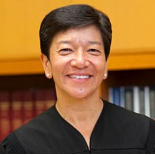

Mary Yu
Non-Partisan | Washington


Candidate Profile

Uncontested

BIOGRAPHY
EDUCATION
Candidate did not provide
WORK & MILITARY
Candidate did not provide
AFFILIATIONS
Candidate did not provide
POLITICAL OFFICES HELD
Candidate did not provide
POLITICAL OFFICES SOUGHT
Candidate did not provide
ENDORSEMENTS
LIBERAL (12)
31st District Democrats (WA)
32nd LD Democrats
37th Legislative District Democrats
Asian Pacific Islander Americans for Civic Empowerment (APACE)
King County Democrats
SELECTED CONTRIBUTIONS
LIBERAL
GIVEN BY CANDIDATE (1)
Local, County, and District Democratic Organizations (2016)
RECEIVED BY CANDIDATE (44)
American Federation of Labor and Congress of Industrial Organizations (2016)
American Federation of State County and Municipal Employees (2016)
Asian and Pacific Islander Americans for Civic Empowerment (2016)
Dan Shih (2016)
Gay and Lesbian Victory Institute (2014)
OTHER INFORMATION
Governor Jay Inslee nominated Justice Yu to the Washington Supreme Court.
Notable quotes:
- "When reviewing cases with regard to the state constitution, we look to the original intent to determine what the words actually mean and what the framers originally intended."
- Justice Yu said she was "just absolutely delighted" about Bostock v. Clayton County (2020) and that Justice Neil Gorsuch "simply read the text carefully" in that case.
- Justice Yu identifies as "the first member of the LGBTQ community to serve on the Washington Supreme Court."
- Justice Yu signed a 2020 letter that said, "The legal community must recognize that we all bear responsibility for this on-going [racial] injustice, and that we are capable of taking steps to address it, if only we have the courage and the will."
Notable court cases:
- Justice Yu signed the majority in Ingersoll v. Arlene's Flowers (2017), in which the Washington Supreme Court declared that not even a strict-scrutiny test would protect a florist's religious freedom to refuse service to gay weddings.
- Justice Yu wrote the majority opinion in Leishman v. Ogden Murphy Wallace, PLLC (2020), holding that a gay man alleging discrimination could not carry out a retaliatory lawsuit against a government contractor.
- Justice Yu signed the dissent in Colvin v. Inslee (2020), which was a case about whether certain prisoners had a right to be released because of the COVID-19 pandemic. The dissent argued that the case should not be dismissed yet because some justices still had important questions to be answered.
- Justice Yu signed the majority opinion in Woods v. Seattle's Union Gospel Mission (2021), which argued that a religious employer could only legally deny someone employment on the basis of sexual orientation if the job in question were ministerial. Justice Yu also wrote a concurrence expressing her hope that religious employers will not exercise their legal power to discriminate on the basis of sexual orientation when hiring ministers.
- The Black v. Central Puget Sound Regional Transit Authority (2020) case concerned a law that failed to meet the Washington Constitution's requirements by amending another law without quoting it. Justice Yu signed the majority opinion, which held that the law in question did not actually violate the Washington Constitution because anyone could understand the new law without conducting research on other laws.
- Justice Yu wrote a concurrence in Eyman v. Wyman (2018), arguing that the majority of the Washington Supreme Court was overstepping the court's authority and that the court ought to honor the letter of the law.
- Justice Yu joined the Washington Supreme Court majority in State v. Gregory (2018), which held that the death penalty as currently administered was unconstitutional because the penalty was administered in a racist way.
- See also State v. Blake (2021), Ass'n of Wash. Bus. v. Dep't of Ecology (2020), In re Recall of Inslee (2019), Watson v. City of Seattle (2017), McCleary v. Washington (2012), and City of Seattle v. McKenna (2011).
QUESTIONNAIRE
VALUES
I agree with Critical Race Theory (CRT) which asserts that the institutions in the United States are fundamentally racist.
Did not answer
Judeo-Christian values established a framework of morality that is necessary for our system of limited government.
Did not answer
Briefly describe your spiritual beliefs and values.
Did not answer
What types of pro bono work have you done?
Did not answer
ABOUT YOU
Have you ever been convicted of a felony or been penalized in either civil or criminal court for sexual misconduct? If so, please explain.
Did not answer
What education or experience qualifies you to hold the office for which you seek election?
Did not answer
Why should the voters choose you?
Did not answer
I voted in these elections:
Did not answer
JUDICIAL PHILOSOPHY
Justices should not interpret the federal and state constitutions as living documents, but should use a textualist and originalist approach to interpretation.
Did not answer
What is the proper use of legislative history in interpreting statutory law?
Did not answer
Which current or past U.S. Supreme Court justice best reflects your judicial philosophy?
Did not answer
How should a court address the balance between public health and individual freedoms in the time of a pandemic?
Did not answer
In light of the case Bostock v. Clayton County, in which the U.S. Supreme Court interpreted the 1964 Civil Rights Act to include a prohibition on sexual-orientation discrimination, which justice’s opinion most closely aligns with your own opinion?
Did not answer
What role (if any) does a judge have in maintaining the separation of church and state?
Did not answer
Religious liberty is at risk in the United States and deserves the highest level of protection in the law.
Did not answer
When should a judge overturn past court decisions?
Did not answer
How should a judge determine which rights are protected by the Constitution even though they are not specifically mentioned?
Did not answer
What legal principles should a court consider when evaluating parents’ objection to their child obtaining medical procedures or drugs designed to affirm the child’s desired gender?
Did not answer
What principles should guide a court’s analysis of whether your state’s constitution gives terminally ill patients a right to assisted suicide?
Did not answer
Would you describe your judicial philosophy as originalist, living constitutionalist, or something else?
Did not answer