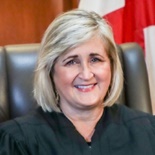

Sarah Stewart
Republican | Alabama
Candidate Profile

Leans Originalist

BIOGRAPHY
Name
Sarah Stewart
Party
Republican
Election Year
2024
Election
Primary
Race
Supreme Court Chief Justice
Incumbent
No
Links


EDUCATION
Candidate did not provide
WORK & MILITARY
Candidate did not provide
AFFILIATIONS
Candidate did not provide
POLITICAL OFFICES HELD
Candidate did not provide
POLITICAL OFFICES SOUGHT
Candidate did not provide
ENDORSEMENTS
CONSERVATIVE (2)
Alabama Farmers Federation (ALFA) FARMPAC
Rick Pate
OTHER INFORMATION
Justice Sarah Stewart (R) is running for Chief Justice of the Alabama Supreme Court. Justice Stewart is married to husband Craig and the couple share two children. The Stewart’s attend Ashland Place Methodist Church
Employment:
- Elected to Alabama Supreme Court in 2018 and assumed office in 2019. Ballotpedia
- She was elected by her fellow judges in July 2018 as the first female president of the Circuit Judges Association.
- Stewart was appointed to the 13 Circuit in Alabama by Gov. Bob Riley (R) won election to a full six-year term in 2010 and was re-elected on November 8, 2016. (2006-2019)
- Received J.D. from Vanderbilt University School of Law.
Notable Associations & Organizations:
- On the Board of Directors for Loaves and Fishes Ministry 15th Place Homeless Day Service Shelter
Judicial Philosophy
- "Alabamians know they can count on Supreme Court Justice Sarah Stewart to strictly construe the law, never legislate from the bench, and enforce the law justly. Just as she has for the last 18 years, Justice Stewart will take her responsibility as a conservative jurist very seriously. Read below what Justice Stewart says about her conservative judicial values." [campaign website]
- "It is important for a justice to have strongly developed judicial values. My record reflects my conservative approach to dispensing justice impartially, ensuring Alabama’s body of jurisprudence evolves in strict accordance with conservative principles. My work as a Circuit Judge and a Justice speaks for itself - I have and will never legislate from the bench and I have and will always stand for Alabamians’ constitutional rights. I will fiercely safeguard our freedoms enshrined in the Constitution - from the right to praise God freely to the power of state government. Five of the original ten amendments to the US Constitution are about the justice system because the Founding Fathers looked to the judicial branch to protect these fundamental freedoms. The Alabama Supreme Court must stand as the final protective barrier to encroachment on the people of Alabama’s rights." [campaign website]
- Stewart said, “Hearing as many cases as I have, with virtually every imaginable circumstance, has only served to deepen my conviction that a judge must be, above all other things, impartial. We must never view a case through the lens of our personal opinions, but through the lens of the law. As a judge, it’s not my job to make law, it’s my job to interpret it…to say what it means and how it applies to each case. For this reason, rulings must be timely, fair, and always grounded in the rule of law. As a conservative Judge, my mission is to apply the rule of law fairly and impartially. That is our highest duty."
Public Statements:
- Said, “Being a conservative judge is not equal to being a social conservative.”
- Campaign video states Stewart will, “Strengthen our courts, defend our Constitution and protect our families”
- Stewart said she ‘tries to adhere to the law and higher court precedent — even when she might not prefer the result,’ saying ‘sometimes as a judge, you have to sign off on an opinion you don’t personally agree with because that’s the law.’” Further stating, “Judges are referees, not policymakers,” Stewart continued.”
- Stewart said, "My mission is to apply the rule of law fairly and impartially. That is our highest duty.”
- A TV ad during her 2018 campaign stated that Stewart will, “Protect our 2nd Amendment gun right”, “Defend the Constitution” and “Guard our national against evil doers”
Notable Cases:
- Doldgencorp, LLC v. Gilliam (2023) Stewart dissented without separate opinion. The court held that, "Gilliam's negligence claim fail[ed] as a matter of law" and "reverse[d] the trial court's judgment and render a judgment in favor of Dolgencorp." (4) The court found "Like in Albert, under the facts of this case, there is 'no duty and no causation; the facts indicate that the cause of the accident was the operation of the [out-of-control] vehicle.'" (3) Issue: "The issue on appeal [was] whether, under the facts presented, the trial court erred in denying Dolgencorp's motions for a JML on the negligence claim based on this Court's holding in Albert. To prevail on her negligence claim, Gilliam was required to prove (1) that Dolgencorp owed her a duty of care, (2) that Dolgencorp breached that duty, (3) that she suffered a loss or injury, (4) and that Dolgencorp's breach was the actual and proximate cause of her loss or injury." (2)
- Munza v. Ivey (2021) Concurred in Bolin's majority. The court held "that the plaintiffs lacked standing to bring their complaint seeking injunctive relief regarding the July 15 proclamation adopting the amended health order that, among other things, requires masks or facial coverings to be worn in certain circumstances." (23) "The plaintiffs' allegations of an imminent threat of enforcement of the July 15 proclamation adopting the amended health order against them differ substantially from those in Parker. The plaintiffs have failed to allege any credible risk of enforcement that would give rise to standing that would support a pre-enforcement action." (19) Further, " Babbitt also requires that a plaintiff allege that 'either (1) he was threatened with prosecution; (2) prosecution is likely; or (3) there is a credible threat of prosecution. American Civil Liberties Union v. The Florida Bar, 999 F.2d 1486, 1492 (11th Cir. 1993)." (19-20) The court found, "[t]he plaintiffs have alleged no facts that would satisfy [Babbitt's] requirements." (20) "The plaintiffs' complaint does not contain a single allegation that any of the plaintiffs have been specifically threatened with enforcement of the fine and incarceration penalties in the July 15 proclamation. Instead, all the plaintiffs alleged was that the July 15 proclamation 'provided threat of fine and incarceration' and that the plaintiffs 'are directly affected by the Proclamation and Order, as they are located within the boundaries of the State of Alabama and, during times, interface with the public at distances of less than six feet.'" (20) Court review lack of subject matter jurisdiction or standing, de novo. (11) The plaintiffs "challeng[ed] a proclamation issued by Governor Kay Ivey requiring the use of facial coverings in certain circumstances[.]" The plaintiffs argued the "[s]aid Proclamation and Order [was] illegal." (15) The defendants argued that the plaintiffs lacked standing to challenge the order. (13)
- November 23, 2020 Order (2020) Signed clerk's rule. Held that video testimony would be permitted in all cases where there is “good cause in compelling circumstances”
- Bolin's dissent argued that the new rule was unconstitutional because "open court" had been interpreted to exclude phone calls and forms of electronic communication. Bolin argued this would create ambiguities over whether individuals speaking over video calls would be said to have committed contempt in "open court."
- March 12, 2020 Order (2020) Signed Bryan's dissent. Argued that judges should be ordered to cancel the jury trials, not simply given the discretion to.
- Magers v. Alabama Women's Center Reproductive Alternatives (2020) Per curiam. The Court dismissed Magers' wrongful death claim because he did not properly argue his case per Rule 28. He simply made a claim and then issued a string citation. "Rule 28 requires the argument section of an appellant's initial brief to set out 'the contentions of the appellant/petitioner with respect to the issues presented, and the reasons therefor, with citations to the cases, statutes, other authorities, and parts of the record relied on.' Rule 28(a)(10), Ala. R. App. P." (2-3) Magers's brief falls far short of this requirement. The Court said, "It is not the responsibility of this Court to construct arguments for a party or to fill in gaps from string citations offered in lieu of arguments. Rather, it is our duty to decide whether the arguments presented have merit." (4-5)
- State v. City of Birmingham (2019) Signed Bryan's majority opinion. Accurate conclusion. Held that the Birmingham "altered" the monument (due to the definition of a monument), and that municipalities had no free speech or due process rights because they are non-sovereign subdivisions of the state. Issue: "whether the City defendants' placement of the plywood screen around the base of the monument 'altered' or 'otherwise disturbed' the monument" thus violating "§ 41-9-232(a), Ala. Code 1975, a part of the Act, that provides: 'No ... monument which is located on public property and has been so situated for 40 or more years may be relocated, removed, altered, renamed, or otherwise disturbed.'" (4) Court reviewed denial of summary judgement, trial court's interpretation of a statute and whether the trial court misapplied the law de novo. (8) Court looked to "plain meaning of words as written by the legislature." (11) "[T]he Supreme Court has firmly, and recently, rejected any notion that a subdivision of the state has any 'privileges or immunities under the federal constitution which it may invoke in opposition to the will of its creator.'" (27) Further, "[a]ny right to have the City's 'government speech" fall within the protections of § 4 of the Alabama Constitution must be specifically conferred by the legislature, and the legislature has not done so.'" (34) The court found that "the City defendants, by violating § 41-9-232(a), are subject to the penalty provision of the Act." (41) "Accordingly, we conclude that, under the circumstances of this case, the City defendants were subject to a single $25,000 fine for their violation of the Act." (43)
QUESTIONNAIRE
RIGHT TO LIFE
Was Dobbs v. Jackson rightly decided according to the text of the Constitution? Please explain.
Did not answer
I support a right to accelerate ending a human life.
Did not answer
Human life deserves legal protection from conception until natural death.
Did not answer
RELIGIOUS LIBERTY
Religious liberty is at risk in the United States.
Did not answer
2ND AMENDMENT
The right to bear arms is fundamental and must be protected.
Did not answer
OTHER IMPORTANT ISSUES
Which branch of government do you believe was intended to wield the most authority?
Did not answer
How should the court address public health and individual freedoms in the time of a public health emergency?
Did not answer
JUDICIAL PHILOSOPHY
Which current or past U.S. Supreme Court justice best reflects your judicial philosophy?
Did not answer
Is there a separation of church and state in the Constitution? Please explain.
Did not answer
Should courts address threats to religious liberty in the United States? If so, how?
Did not answer
Was Obergefell v. Hodges rightly decided according to the text of the Constitution? Please explain.
Did not answer
Was Bostock v. Clayton County rightly decided under the law? Please explain.
Did not answer
I agree that “the custody, care and nurture of the child reside first in the parents, whose primary function and freedom include preparation for obligations the state can neither supply nor hinder.” (Troxel v. Granville, 530 U.S. 57, 65-66 (2000); quoting Prince v. Massachusetts, 321 U.S. 158, 166 (1944).
Did not answer
What should a judge do when legislative texts and court precedents dictate different results?
Did not answer
When should a judge overturn past court decisions?
Did not answer
When, if ever, should a judge take popular opinion or the social views of the majority into consideration?
Did not answer
Do you believe the meaning of the Constitution changes over time, absent changes through the amendment process of Article V?
Did not answer
What do you believe is the single most important quality a judge should possess?
Did not answer
If you are an incumbent judge, describe a recent instance in which you acted to preserve your judicial independence. If you are an aspiring judge, how do you plan to remain independent if elected to the bench?
Did not answer
ABOUT YOU
What, if any, church or organizations do you belong to?
Did not answer
I voted in these primaries and general elections:
Did not answer
Have you ever been convicted of a felony? If so, please explain.
Did not answer
Have you ever been penalized for sexual misconduct in either civil or criminal court? If so, please explain.
Did not answer
Would you describe your judicial philosophy as originalist, living constitutionalist, or something else? Please explain.
Did not answer
VALUES
Briefly describe your spiritual beliefs and values.
Did not answer
What is your view of parental rights regarding the upbringing of children, specifically education and sexual "identity"?
Did not answer
I support "gender identity" as a specially protected class. Please explain.
Did not answer
What do you believe to be true about the human condition?
Did not answer
EQUALITY
I agree with Critical Race Theory (CRT).
Did not answer